
• Welcome to SpeedSolving.com — the world’s largest puzzle community!

    You’re currently browsing as a guest, which means you have limited access to discussions, resources, member profiles, and community features.

    Join 50,000+ cubers and puzzle enthusiasts from around the world to ask questions, share solves, improve faster, and be part of the community.

    Registration is free, fast, and easy — create your account today.

    Already a member? Log in here to hide this message and start participating.

Drawing <M,U> algs to better learn them

SoundBalloon

Member
Joined
Apr 21, 2018
Messages
15
Location
France
WCA
2016LEHE01
(Note to moderators: I am not sure if this thread is in the correct subforum. If it isn't, please move it where it belongs. Thank you :) )

Here is an idea to draw algs that exclusively use M and U moves (and M', M2 executed as M2', U' and U2).

From experience I find these algs hard to memo in bulk, because of the repetitivity of them compared to even <R,U,F> algs. Of course, one can decompose algs into triggers, but it doesn't always help. So here is an idea that might help you recall those pesky algs more vividly. While it is nothing groundbreaking, it doesn't aim to be: I just wanted another way to visualize the algs, because the more ways I have, the easier it is to remember them. And it did help me a lot!

Here is how it works. You group every (M* U*) (where the * stands for anything, so nothing, ', or 2) and draw one of 9 arrows (vectors really) depending on the number of M and U turns. If you start with a U or end with a M you need another arrow, thus the extra six cases below. Every arrow is concatenated. You end up with a line forming a neat pattern!

Also, important fact: the lines are supposed to reflect how the UF piece moves when you do the move. If you do M'U', it moves up and right, thus the arrow is towards the top right.
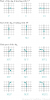

MUshorthand-reference.png
(If you use U2' instead of U2, you may want to symmetrize the U2, M'U2, MU2 and M2U2 arrows.)

And some examples:
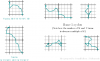
MUshorthand-examples.png

(Sorry if the resolution is meh. The images are originally in .pdf, but I did not find how to upload .pdf files to the forum directly. Let me know if there is a way!)
 
Last edited:
This looks cool! But I don't think this is ideal for speedsolving, because recalling visual images is usually quite slow compared to muscle memory. Maybe a modified version of this could make it useful for something like BLD or FMC.
 
I remember M U algs by counting the quarter turns. For example M2 U M2 U2 M2 U M2 is 2 1 2 2 2 1 2. So there is a certain rhythm: U, U2, U, surrounded by M2 moves. The Z perm I use is M' U' M2 U' M2 U' M' U2 M2 U, which can be written as (1 1) (2 1) (2 1) (1 2 2 1*) with the different AUF at the end. This "rhythm" method is also mentioned by Antoine Cantin in some video long ago. For U perms, I also remember when there is a M push or a U flick. Almost all algs have the total turns of each face as a multiple of four to return to the original rotation of the face, however the <R,U> U perms are an exception.
 
This looks cool! But I don't think this is ideal for speedsolving, because recalling visual images is usually quite slow compared to muscle memory. (...)
Thanks! You got it right. I wanted help for the first step of learning an alg: to commit it to memory (so I do not have to look at my cheat sheet every few algs). Ultimately I plan to drill them until they become muscle memory.

(...) Maybe a modified version of this could make it useful for something like BLD or FMC.
If you develop one, let me know!

I remember M U algs by counting the quarter turns. (...) So there is a certain rhythm: (...)
Nice! Remembering the "flow" is another method I use, though not like you describe it. My three main methods to learn <M,U> algs are:
1. decomposing the alg into subalgs (various 3-cycles, triggers, 5-cycles...)
2. remembering the flow, or rythm, of the alg (basically learning the "feeling" when executing it)
3. (new) the drawings above.
I'll remember the number technique, that could be useful, thanks qwr :)

How many MU algs are you using. There aren't that many that you need.
I am learning <M,U> 5-cycles. There are 48 of those, and many of those that I chose are <M,U>.
 
Last edited:
what are the 5 cycles for?
Can be for a couple things. Roux L6E without having EO if you manage to place one piece (I plan to add 22-cycles, 3-cycles, and the variants where an extra piece or two are misoriented), though the recognition will probably be hell. I plan to see if it can be useful for blind, as a subset of 5style.
 
  • Like
Reactions: qwr
How many MU algs are you using. There aren't that many that you need.

LMCF has more than 250 MU algorithms of which I only know less than half. Indeed learning MU algs is very annoying, it takes me 4 times longer to learn one vs. other styles of algorithms and I have shown that I can't learn more than 2 per day. Plus, the more you know, the harder it is to learn more because each new alg becomes very similar to at least one other MU alg you already know, creating failures on the previous alg until you 'disentangle' the two similar algs training them side by side. In fact I hate learning MU's so much that I delay those sets and prefer to learn other sets. So the image method is pretty cool, though personally I would only use vertical and horizontal lines (no curves like shown above). The images would only be useful in the early stages, until muscle memory takes over.
 
LMCF has more than 250 MU algorithms of which I only know less than half. Indeed learning MU algs is very annoying, it takes me 4 times longer to learn one vs. other styles of algorithms and I have shown that I can't learn more than 2 per day. Plus, the more you know, the harder it is to learn more because each new alg becomes very similar to at least one other MU alg you already know, creating failures on the previous alg until you 'disentangle' the two similar algs training them side by side. (...)
Very true! Usually having algs that look similar helps me memorize them, because it's pretty rare. For <M,U> algs it's the contrary: just like you say, it's just confusing.

Also, the picture method is only a starting point. You still have to give meaning to the drawings, link it to the configuration you want to learn, make it emotional... in short, any tricks to make it stick. And if you end up using a variant of my drawing idea to memo algs, post it here with what you do differently, I'd be very interested!
 
I can't see the picture method being successful in non blind solves, although I only know a few algs so I'm not a good source of whether a memorization technique is good or not. I think it would be easier to just associate each alg with a rhythm and possibly put it to a tune. (Keep in mind I am slightly more inclined in music than visual arts, but through and through amateur by any standard).

Here's something I just made up a few minutes ago that would be how I would try to memorize similar looking 2-gen algs. We take advantage of the structure of 2-gen algs that they always alternate letters. H perm looks like this:

M' M' U - | M' M' U U | M' M' U - | M' M'

and imagine that rhythm being played as quarter notes with M being the kick drum and U being the snare. (That's actually how I remember the 4 <M,U> algs I know). Then for opposite turns, like M and U' (I do M slices with my left hand and U with my right hand, so M' and U are far easier than M and U'), you could just memorize them or imagine being differently pitched kick drum and snare drum sounds. So my U perm is like

M' M' U' M | U U M' U' | M' M'
K K s K | S S K s | K K

Where different capitalization means differently pitched sounds, but actually awkward opposite moves with my fingers. I don't actually think of the sounds in my head but I follow the rhythm when doing the execution.

Ok I reread my post and it sounds kinda like insane 3 AM ramblings but idk maybe it'll inspire someone.
 
Looks good! It seems like an version of Cushan notation (https://www.cushan.io).
This looks kinda like CuShan.
Yes and no.

Yes because both are drawings using arrows. By that measure a 3x3 looks kinda like a skewb.

No because where CuShan is meant as an alternative notation for beginners, my drawing method is meant for people who have to learn algs. It provides help for memorizing them. Also, it is quite specific, as it only encodes <M,U> algs, which are the most difficult to learn imo.
 
It looks like this is for LSE/Roux
It could, but I don't think it will. It could, in the sense that <M,U> algs are mostly encountered in Roux among the main methods. However most Roux users emphasize the intuitiveness of the L6E stage, so I don't think this would be very useful for a Roux user, unless they are trying to solve L6E with algs.

It might, however, be interesting for other, less mainstream methods. Mehta's method ( https://www.speedsolving.com/threads/cfop-breaker-mehta-method.78352/ ) considered using 5-cycles in <M,U> before switching to EO then 5-cycles in <R,U>. I am working on an experimental blind method that heavily uses around 50 5-cycles, many of them <M,U>. The latter is where I currently use my drawings method.
 
(Note to moderators: I am not sure if this thread is in the correct subforum. If it isn't, please move it where it belongs. Thank you :) )

Here is an idea to draw algs that exclusively use M and U moves (and M', M2 executed as M2', U' and U2).

From experience I find these algs hard to memo in bulk, because of the repetitivity of them compared to even <R,U,F> algs. Of course, one can decompose algs into triggers, but it doesn't always help. So here is an idea that might help you recall those pesky algs more vividly. While it is nothing groundbreaking, it doesn't aim to be: I just wanted another way to visualize the algs, because the more ways I have, the easier it is to remember them. And it did help me a lot!

Here is how it works. You group every (M* U*) (where the * stands for anything, so nothing, ', or 2) and draw one of 9 arrows (vectors really) depending on the number of M and U turns. If you start with a U or end with a M you need another arrow, thus the extra six cases below. Every arrow is concatenated. You end up with a line forming a neat pattern!

Also, important fact: the lines are supposed to reflect how the UF piece moves when you do the move. If you do M'U', it moves up and right, thus the arrow is towards the top right.


View attachment 14136
(If you use U2' instead of U2, you may want to symmetrize the U2, M'U2, MU2 and M2U2 arrows.)

And some examples:

View attachment 14137

(Sorry if the resolution is meh. The images are originally in .pdf, but I did not find how to upload .pdf files to the forum directly. Let me know if there is a way!)
Interesting geometric way of visualizing the LSE algsets.

A similar visualization tool exists (cushan.io), but I think this way of representation is better as there is no 3 lines or something like that. (in cushan notation there is 3 parallel lines just to show which layer is selected to turn and the direction of turn.)

I personally use Yo notation to memorise 5-cycles from the UF buffer, which is a super set of the LSE group. One example is, the alg (UL-DR-RB-DF ) U' F' E' R E2 R E R2 E2 F U becomes 'bwqj rjpl rva' in Yo notation, and I can visualize a PAO sentence for it.
bwqj rjpl rva becomes barking megaminx owned by rajpal (a guy) becomes rava (a form of grain).
 
Using this notation are you able to start with a blank square grid and come up with M,U algorithms from scratch?
 
Back
Top