Collin Burns 5.25 WR Single Played on a Piano

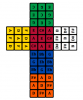
I assigned the chords shown in the video:
Green: C-Major
Yellow: D-Minor
Red: A-Major
White: B-Major
Blue: Eb-Major
Orange: D-Major

This is how all the notes were mapped onto each face:
Screen Shot 2015-11-09 at 3.20.57 pm.png
 
even as a decent pianist this confuses me immensely

Not sure if this helps, but the first half of the chord progression maps the notes played on the white face because he starts with white. After he finishes F2L, it switches to yellow. Using the method described in the TED video, only the notes on one single face are played at a time. Therefore, given the layer-by-layer structure of CFOP, it makes sense to play the notes on the cross face for cross and F2L, and then the notes on the opposite face for OLL and PLL.
 
what if you do this, but have it play the notes of each face when it is turned?

I thought about that - it seems less arbitrary than tracking just two individual faces. But if the notes of every face were played, every turn would sound the same because all the notes would always be played at the same time. So it wouldn't reflect any progression from the scrambled state to the solved state.

I wonder if there are other, better ways to represent a full permutation of the cube with chords.

Collin is not very good at the piano.

;)

It would be interesting to take the chord progression of a REAL song and use that to scramble the cube. I wonder if any particularly repetitive tunes would actually produce interesting color patterns...
 
Last edited by a moderator:
I thought about that - it seems less arbitrary than tracking just two individual faces. But if the notes of every face were played, every turn would sound the same because all the notes would always be played at the same time. So it wouldn't reflect any progression from the scrambled state to the solved state.

I wonder if there are other, better ways to represent a full permutation of the cube with chords.
but wouldn't the notes be different every turn, so the sound would be different every time
 
This sounds exactly like it could have been written by Toru Takemitsu or Iannis Xenakis or any other number of post modernist classical composers lol.
 
but wouldn't the notes be different every turn, so the sound would be different every time

Do you mean that all of the notes for every face would be played at the same time?

This sounds exactly like it could have been written by Toru Takemitsu or Iannis Xenakis or any other number of post modernist classical composers lol.

Interesting... :D

Let's do a Vangelis scramble.
Lots of R moves.

Yes! :tu
 
Last edited by a moderator:
Back
Top