
Hi everyone!
In this thread, I want to show you a puzzle I have recently constructed that serves as a proof of concept for a new mechanism I've come up with.
This 3x3 differs from the standard mechanism by using a 2x2 core with the corners extended and the gaps filled in with edges and centers. Because of this construction, a connection is made between the outer layers allowing them to be made to turn slower than the inner slices. The reason we would want to do this is primarily because this allows us to do slice moves with one hand without the need for table abuse, giving us more control of what turns we want to make. It could also be beneficial for 2-handed solving, say with roux or 3-style, where one simply wants slices that are faster than outer layers. The addition of the 2x2 core essentially gives us even more ability to control the feel of each type of move.
However, my prototype made from a wrm v10 and a qiyi keychain turns incredibly poorly, I'm making this thread partially to get opinions and ideas on this, but also partially to garner interest and find people who have the knowledge and means to create a proper speedcubing-viable 3x3 with this mechanism. I believe it's fully possible, as 2x2s and 3x3s are not too difficult anymore and this mechanism is simply a combination of the two.
See this youtube video and the attached images for a demonstration and a showcase of the mechanism.
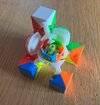
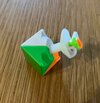


 I want to get into 3D-printing for puzzle making/modding in general, so at most I'll probably ask around for advice to get the best print quality possible. Gonna be learning 3D-modeling now and try to make a 3x3 shell that goes on top of a gan 251 leap. I think the strong corner-core magnets in it will be helpful to achieve the free-moving slices feature without sacrificing outer layer speed too much. Once/if I get a working design I'm happy with I'll make another video and share it to others. I will probably make a few versions and ask for people to try them out to compare, as I believe some tinkering with milliput/sanding will be necessary as well in order to get the best overall quality.


