A rediscovered 3x3 mechanism that can make outer layers slower than inner slices

Edde

Member
Joined
Nov 23, 2024
Messages
24
Location
Sweden
Hi everyone!

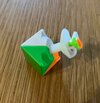
In this thread, I want to show you a puzzle I have recently constructed that serves as a proof of concept for a new mechanism I've come up with.

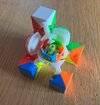
This 3x3 differs from the standard mechanism by using a 2x2 core with the corners extended and the gaps filled in with edges and centers. Because of this construction, a connection is made between the outer layers allowing them to be made to turn slower than the inner slices. The reason we would want to do this is primarily because this allows us to do slice moves with one hand without the need for table abuse, giving us more control of what turns we want to make. It could also be beneficial for 2-handed solving, say with roux or 3-style, where one simply wants slices that are faster than outer layers. The addition of the 2x2 core essentially gives us even more ability to control the feel of each type of move.

However, my prototype made from a wrm v10 and a qiyi keychain turns incredibly poorly, I'm making this thread partially to get opinions and ideas on this, but also partially to garner interest and find people who have the knowledge and means to create a proper speedcubing-viable 3x3 with this mechanism. I believe it's fully possible, as 2x2s and 3x3s are not too difficult anymore and this mechanism is simply a combination of the two.

See this youtube video and the attached images for a demonstration and a showcase of the mechanism.
 

Attachments

  • IMG_1877.jpg
    IMG_1877.jpg
    341.9 KB · Views: 44
  • IMG_1878.jpg
    IMG_1878.jpg
    400 KB · Views: 44
Amazing job, I’m still not quite sure how the mechanism even works. I hope you keep pioneering this idea
Thanks! I try to explain it in my video, essentially, A,B and C represents the friction between the 3 layers. In standard 3x3s, we only have B and C, A = 0. But to get the effect where we can do slice turns with one hand, we need A > B=C (I believe we don't need A>B+C, but I might be wrong). My design achieves this, by introducing the 2x2 core that acts as the necessary connection between the outer layers to create the friction A.

We can also put it this way: a standard 3x3 will always have inner slices slower than outer layers, because the friction will be 2x the friction for an outer layer. This new design bypasses that restriction and makes it possible to, somewhat paradoxically, have the inner slices faster than the outer layers.

In many ways, the design is "done" now, because at its conceptual level, the idea is simply about using a 2x2 core for 3x3. Should be noted that we can easily add all kinds of core magnets here and there, but that's a bit besides the main point. This also means that the next step now is to create a proper version that one can actually use for speedcubing, which I simply cannot do since, even if I were to buy a 3D-printer I don't have any puzzle designing experience.
 
Turns out, to nobody's surprise I suppose, that Oskar made this in the past. He's truly the Euler of puzzle design haha. I think it's still good to bring up the possibility of making a proper speedcube version of this, as standard hardware wasn't as developed as it is nowadays. Magnets weren't really around back then, and they are probably integral to get the stability needed to do this in a reasonable way.

I plan on getting a 3D-printer, probably a bambu labs mini a1, and try to design a 3x3 shell that could go on a modern 2x2 like a gan 2x2. The inner core is what largely affects the overall performance of the cube, so starting with something good there should be the way to go for now.
 
Thanks! I try to explain it in my video, essentially, A,B and C represents the friction between the 3 layers. In standard 3x3s, we only have B and C, A = 0. But to get the effect where we can do slice turns with one hand, we need A > B=C (I believe we don't need A>B+C, but I might be wrong). My design achieves this, by introducing the 2x2 core that acts as the necessary connection between the outer layers to create the friction A.

We can also put it this way: a standard 3x3 will always have inner slices slower than outer layers, because the friction will be 2x the friction for an outer layer. This new design bypasses that restriction and makes it possible to, somewhat paradoxically, have the inner slices faster than the outer layers.

In many ways, the design is "done" now, because at its conceptual level, the idea is simply about using a 2x2 core for 3x3. Should be noted that we can easily add all kinds of core magnets here and there, but that's a bit besides the main point. This also means that the next step now is to create a proper version that one can actually use for speedcubing, which I simply cannot do since, even if I were to buy a 3D-printer I don't have any puzzle designing experience.
I understand it now, the 2x2 like core only effects the corners. In terms of 3D printing, if you are passionate about this I suggest trying to learn some 3D modeling, it is not difficult to design a 3x3, I imagine this just takes some repetition of the 3x3 concept, if you can squeeze out a design, there are people, including me, that would be more than happy to 3D print one for you, and evens end you a copy once a useable prototype has been achieved.
 
I understand it now, the 2x2 like core only effects the corners. In terms of 3D printing, if you are passionate about this I suggest trying to learn some 3D modeling, it is not difficult to design a 3x3, I imagine this just takes some repetition of the 3x3 concept, if you can squeeze out a design, there are people, including me, that would be more than happy to 3D print one for you, and evens end you a copy once a useable prototype has been achieved.
I actually ordered a bambu labs a1 mini just now :P I want to get into 3D-printing for puzzle making/modding in general, so at most I'll probably ask around for advice to get the best print quality possible. Gonna be learning 3D-modeling now and try to make a 3x3 shell that goes on top of a gan 251 leap. I think the strong corner-core magnets in it will be helpful to achieve the free-moving slices feature without sacrificing outer layer speed too much. Once/if I get a working design I'm happy with I'll make another video and share it to others. I will probably make a few versions and ask for people to try them out to compare, as I believe some tinkering with milliput/sanding will be necessary as well in order to get the best overall quality.
 
IMG_2037.webp

I realize I should give an update here, I have practically finished my improved version, waiting for a small order with some magnets to be added and I'll need to add stickers. Due to the 3D-printed pieces I will also have to do a bit of break-in while waiting. Hopefully I'll be able to release a video about it by the end of next week, mainly assuming the last magnets arrive in time.

I want to be a little secretive so there's a reason to watch the video, but in short, it's really good. Most of the issues are a result of having to use 3D-printed pieces, meaning a mass-produced version would solve them for the most part. To me, the potential of this mechanism has risen even further knowing how easy it is to make a quite functional cube with it, keep in mind I had no CAD or 3D-printing experience going into this, yet was able to make something that almost feels better than standard speedcubes.
 
Back
Top