Melinda's Physical 2x2x2x2 Example Solve Game

Renslay

Legend
Joined
Aug 1, 2011
Messages
2,656
Location
Hungary
WCA ID
2005HANT01
YouTube
Visit Channel
Welcome to the Melinda's Physical 2x2x2x2 Example Solve Game!

As you might noticed, Twizzle supports Melinda's 2x2x2x2, but for some reason, there is no single notation for a gyro move. But it supports some moves that although are NOT valid moves, can be easily performed on an actual physical cube: and with them, I discovered a yx-gyro move that contain only 6 sub-steps.

This is the yx-gyro move:
Oy My' B2 U2 Lx2 F2
 Twizzle link 
(Oy My' B2 U2 Lx2 F2) // gyro


Although I do not recommend to perform this specific series of moves on a physical cube; Oy is a weird turn. But the end result is a valid gyro in yx-direction: it moves U->R->D->L->U cells around, while leaving the F/B/I/O cells.

Here is the complete list of the possible moves on twizzle:

 Twizzle link 
// cube rotations
x x' x2 y2 z2

// yx-gyro sequence (no direct notation for it...)
(Oy My' B2 U2 Lx2 F2)

// left/right cell turns
Lx Ly Lz Rx Ry Rz
Lx' Ly' Lz' Rx' Ry' Rz'
Lx2 Ly2 Lz2 Rx2 Ry2 Rz2

// up/down/front/back cell turns (double only)
U2 D2 F2 B2

// canonical inner/outer cell turns
Mx Ox
Mx' Ox'
Mx2 Ox2

// non-canonical (but valid) inner/outer turns
My2 Mz2 Oy2 Oz2

// INVALID INNER/OUTER TURNS, use only in scrambles!
My Mz Oy Oz
My' Mz' Oy' Oz'


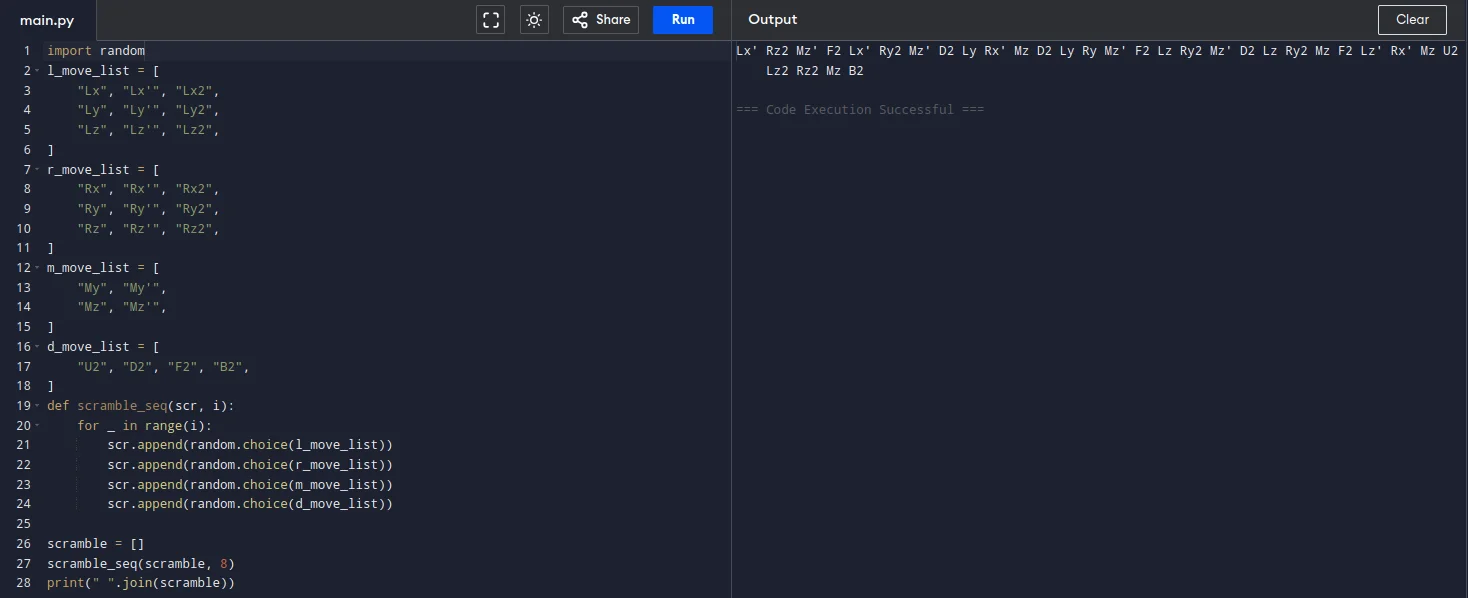
As for the scrambling, I couldn't find any official scrambler for the physical 2x2x2x2. So I wrote a little Python code that does the following: select one random L-cell turn, R-cell turn, M-cell turn, and U2/D2/F2/B2 turn, in this order, and repeats this 8 times. Note that I only chose My, My', Mz and Mz' moves for the M cell: these are invalid turns, but keep the puzzle in a solvable state, and also act like a short gyro-like scramble.

Maybe this is not the most efficient scrambling, I am open for suggestions. Here is the Python code (just copy-paste into an online Python interpreter website, for example https://www.programiz.com/python-programming/online-compiler/ and hit the RUN button. Feel free to change it if you don't like the result).
Python:
import random
l_move_list = [
    "Lx", "Lx'", "Lx2",
    "Ly", "Ly'", "Ly2",
    "Lz", "Lz'", "Lz2",
]
r_move_list = [
    "Rx", "Rx'", "Rx2",
    "Ry", "Ry'", "Ry2",
    "Rz", "Rz'", "Rz2",
]
m_move_list = [
    "My", "My'",
    "Mz", "Mz'",
]
d_move_list = [
    "U2", "D2", "F2", "B2",
]
def scramble_seq(scr, i):
    for _ in range(i):
        scr.append(random.choice(l_move_list))
        scr.append(random.choice(r_move_list))
        scr.append(random.choice(m_move_list))
        scr.append(random.choice(d_move_list))

scramble = []
scramble_seq(scramble, 8)
print(" ".join(scramble))

Screenshot:
1785754221360.webp


Keep in mind that the middle part between the brackets are the yx-gyro moves FOR TWIZZLE. In reality, there are more comfortable yx-gyro moves. I use this equence for example for the same effect:
left-2x2-cap-to-right, Ly, Ry', right-2x2-cap-to-left, Rx2, B2, U2, Rx2

And here is the first scramble! (EDIT: I upgraded the scrambling python code; this was generated with the old one)
Ly' Rx' My' U2 Lz2 Rz Mx2 U2 Lz Ry' Mx U2 Lx Rx Mz2 U2 Lz2 Ry Mz F2

And my solution:

 Twizzle link 
 Setup 
Ly' Rx' My' U2 Lz2 Rz Mx2 U2 Lz Ry' Mx U2 Lx Rx Mz2 U2 Lz2 Ry Mz F2
 Moves 
x'
Rx2 D2 Rz Lz Ly2 // right npp-prep
Mx Ly Mx Lz Mx Lz' Mx' Lz Mx' Lz' Ly' Mx' // left npp-prep (F R U R' U' F')
Rz (Oy My' B2 U2 Lx2 F2) // npp (yx-gyro)
Ly' Lx' B2 Ry Mx2 Ry' B2 Ry // right pp
Mx Ly Mx' x' Ly // left pp-prep
Mx Ly Mx Lz Mx Lz' Mx' Lz Mx' Lz' Ly' Mx' // left pp (F R U R' U' F')
Lx' Rz (Oy My' B2 U2 Lx2 F2) Rz Lx Ly x Ly // pre-parity (yx-gyro)
Mx Lz Mx Lz' Mx' Lz Mx' // pairty (R U R' U')
Ly Lz Rz' (Oy My' B2 U2 Lx2 F2) // post-parity (yx-gyro)
Rz (Oy My' B2 U2 Lx2 F2) // pp on outside (yx-gyro)
Mx' Ly' Rz Mx' Rz' B2 Ly Rz Mx' Lz D2 // pp sorted
Mx' Lz' Mx2 Lz Mx Lz' Mx2 // purple-white 1x2x2
D2 Rz Mx' Lz' Mx2 // purple-yellow 1x2x2 - 1
Lz Mx' Lz' Mx Lz Mx Lz' Mx' // purple-yellow 1x2x2 (U' R U R')
Rz Ry' D2 // purple 2x2x2
Lz' Mx' Lz Mx2 Lz' Mx' // pink-white 1x2x2
Mx' Lz Mx' Lz' Mx' Ly' Mx Ly Mx Ly' Mx' Ly Mx Lz Mx' Lz' Mx' Lz Mx2 Lz' Mx // pink CLL (R' U' R' F R F' R U' R' U2 R)
Ly' Lx2 // AUF


(Here, npp means non-purple/pink, pp means purple/pink.)

The method I used here is my own creation (developed after learning about RKT), called Dimension Reduction Orthega - you can read more about it here: https://github.com/HantosNorbert/Dimension-Reduction-Ortega

NEXT:
Ly2 Rz2 Mx' U2 Lz' Ry Mx2 F2 Lz Rx Mz2 D2 Ly2 Rz' Mz' F2 Lz' Rz2 My2 F2

UPDATE: updated Python script, with explicit yx-gyro inserted.
UPDATE 2: updated the Python script again, as the previous one is proved to be too weak.
 
Last edited:
Welcome to the Melinda's Physical 2x2x2x2 Example Solve Game!

As you might noticed, Twizzle supports Melinda's 2x2x2x2, but for some reason, there is no single notation for a gyro move. But it supports some moves that although are NOT valid moves, can be easily performed on an actual physical cube: and with them, I discovered a yx-gyro move that contain only 6 sub-steps.

This is the yx-gyro move:
Oy My' B2 U2 Lx2 F2
 Twizzle link 
(Oy My' B2 U2 Lx2 F2) // gyro


Although I do not recommend to perform this specific series of moves on a physical cube; Oy is a weird turn. But the end result is a valid gyro in yx-direction: it moves U->R->D->L->U cells around, while leaving the F/B/I/O cells.

Here is the complete list of the possible moves on twizzle:

 Twizzle link 
// cube rotations
x x' x2 y2 z2

// yx-gyro sequence (no direct notation for it...)
(Oy My' B2 U2 Lx2 F2)

// left/right cell turns
Lx Ly Lz Rx Ry Rz
Lx' Ly' Lz' Rx' Ry' Rz'
Lx2 Ly2 Lz2 Rx2 Ry2 Rz2

// up/down/front/back cell turns (double only)
U2 D2 F2 B2

// canonical inner/outer cell turns
Mx Ox
Mx' Ox'
Mx2 Ox2

// non-canonical (but valid) inner/outer turns
My2 Mz2 Oy2 Oz2

// INVALID INNER/OUTER TURNS, use only in scrambles!
My Mz Oy Oz
My' Mz' Oy' Oz'


As for the scrambling, I couldn't find any official scrambler for the physical 2x2x2x2. So I wrote a little Python code that does the following: select one random L-cell turn, R-cell turn, M-cell turn, and U2/D2/F2/B2 turn, in this order, and repeats this 5 times. Note that some of the M moves are invalid (but keeps the puzzle in a solvable state), and acts as a sort-of gyro-scramble.

Maybe 5 repetition is not enough, maybe a gyro move should be enforced in the middle - I am open for suggestions. Here is the Python code (just copy-paste into an online Python interpreter website, for example https://www.programiz.com/python-programming/online-compiler/ and hit the RUN button. Feel free to change it if you don't like the result).
Python:
import random
l_move_list = [
    "Lx", "Lx'", "Lx2",
    "Ly", "Ly'", "Ly2",
    "Lz", "Lz'", "Lz2",
]
r_move_list = [
    "Rx", "Rx'", "Rx2",
    "Ry", "Ry'", "Ry2",
    "Rz", "Rz'", "Rz2",
]
m_move_list = [
    "Mx", "Mx'", "Mx2",
    "My", "My'", "My2",
    "Mz", "Mz'", "Mz2",
]
d_move_list = [
    "U2", "D2", "F2", "B2",
]
scramble = []
for _ in range(5):
    scramble.append(random.choice(l_move_list))
    scramble.append(random.choice(r_move_list))
    scramble.append(random.choice(m_move_list))
    scramble.append(random.choice(d_move_list))
print(" ".join(scramble))

Screenshot:
View attachment 50027

And here is the first scramble!
Ly' Rx' My' U2 Lz2 Rz Mx2 U2 Lz Ry' Mx U2 Lx Rx Mz2 U2 Lz2 Ry Mz F2

And my solution:

 Twizzle link 
 Setup 
Ly' Rx' My' U2 Lz2 Rz Mx2 U2 Lz Ry' Mx U2 Lx Rx Mz2 U2 Lz2 Ry Mz F2
 Moves 
x'
Rx2 D2 Rz Lz Ly2 // right npp-prep
Mx Ly Mx Lz Mx Lz' Mx' Lz Mx' Lz' Ly' Mx' // left npp-prep (F R U R' U' F')
Rz (Oy My' B2 U2 Lx2 F2) // npp (yx-gyro)
Ly' Lx' B2 Ry Mx2 Ry' B2 Ry // right pp
Mx Ly Mx' x' Ly // left pp-prep
Mx Ly Mx Lz Mx Lz' Mx' Lz Mx' Lz' Ly' Mx' // left pp (F R U R' U' F')
Lx' Rz (Oy My' B2 U2 Lx2 F2) Rz Lx Ly x Ly // pre-parity (yx-gyro)
Mx Lz Mx Lz' Mx' Lz Mx' // pairty (R U R' U')
Ly Lz Rz' (Oy My' B2 U2 Lx2 F2) // post-parity (yx-gyro)
Rz (Oy My' B2 U2 Lx2 F2) // pp on outside (yx-gyro)
Mx' Ly' Rz Mx' Rz' B2 Ly Rz Mx' Lz D2 // pp sorted
Mx' Lz' Mx2 Lz Mx Lz' Mx2 // purple-white 1x2x2
D2 Rz Mx' Lz' Mx2 // purple-yellow 1x2x2 - 1
Lz Mx' Lz' Mx Lz Mx Lz' Mx' // purple-yellow 1x2x2 (U' R U R')
Rz Ry' D2 // purple 2x2x2
Lz' Mx' Lz Mx2 Lz' Mx' // pink-white 1x2x2
Mx' Lz Mx' Lz' Mx' Ly' Mx Ly Mx Ly' Mx' Ly Mx Lz Mx' Lz' Mx' Lz Mx2 Lz' Mx // pink CLL (R' U' R' F R F' R U' R' U2 R)
Ly' Lx2 // AUF


(Here, npp means non-purple/pink, pp means purple/pink.)

The method I used here is my own creation (developed after learning about RKT), called Dimension Reduction Orthega - you can read more about it here: https://github.com/HantosNorbert/Dimension-Reduction-Ortega

NEXT:
Ly2 Rz2 Mx' U2 Lz' Ry Mx2 F2 Lz Rx Mz2 D2 Ly2 Rz' Mz' F2 Lz' Rz2 My2 F2
HELL NAH
 
Welcome to the Melinda's Physical 2x2x2x2 Example Solve Game!

As you might noticed, Twizzle supports Melinda's 2x2x2x2, but for some reason, there is no single notation for a gyro move. But it supports some moves that although are NOT valid moves, can be easily performed on an actual physical cube: and with them, I discovered a yx-gyro move that contain only 6 sub-steps.

This is the yx-gyro move:
Oy My' B2 U2 Lx2 F2
 Twizzle link 
(Oy My' B2 U2 Lx2 F2) // gyro


Although I do not recommend to perform this specific series of moves on a physical cube; Oy is a weird turn. But the end result is a valid gyro in yx-direction: it moves U->R->D->L->U cells around, while leaving the F/B/I/O cells.

Here is the complete list of the possible moves on twizzle:

 Twizzle link 
// cube rotations
x x' x2 y2 z2

// yx-gyro sequence (no direct notation for it...)
(Oy My' B2 U2 Lx2 F2)

// left/right cell turns
Lx Ly Lz Rx Ry Rz
Lx' Ly' Lz' Rx' Ry' Rz'
Lx2 Ly2 Lz2 Rx2 Ry2 Rz2

// up/down/front/back cell turns (double only)
U2 D2 F2 B2

// canonical inner/outer cell turns
Mx Ox
Mx' Ox'
Mx2 Ox2

// non-canonical (but valid) inner/outer turns
My2 Mz2 Oy2 Oz2

// INVALID INNER/OUTER TURNS, use only in scrambles!
My Mz Oy Oz
My' Mz' Oy' Oz'


As for the scrambling, I couldn't find any official scrambler for the physical 2x2x2x2. So I wrote a little Python code that does the following: select one random L-cell turn, R-cell turn, M-cell turn, and U2/D2/F2/B2 turn, in this order, and repeats this 5 times. Note that some of the M moves are invalid (but keeps the puzzle in a solvable state), and acts as a sort-of gyro-scramble.

Maybe 5 repetition is not enough, maybe a gyro move should be enforced in the middle - I am open for suggestions. Here is the Python code (just copy-paste into an online Python interpreter website, for example https://www.programiz.com/python-programming/online-compiler/ and hit the RUN button. Feel free to change it if you don't like the result).
Python:
import random
l_move_list = [
    "Lx", "Lx'", "Lx2",
    "Ly", "Ly'", "Ly2",
    "Lz", "Lz'", "Lz2",
]
r_move_list = [
    "Rx", "Rx'", "Rx2",
    "Ry", "Ry'", "Ry2",
    "Rz", "Rz'", "Rz2",
]
m_move_list = [
    "Mx", "Mx'", "Mx2",
    "My", "My'", "My2",
    "Mz", "Mz'", "Mz2",
]
d_move_list = [
    "U2", "D2", "F2", "B2",
]
scramble = []
for _ in range(5):
    scramble.append(random.choice(l_move_list))
    scramble.append(random.choice(r_move_list))
    scramble.append(random.choice(m_move_list))
    scramble.append(random.choice(d_move_list))
print(" ".join(scramble))

Screenshot:
View attachment 50027

And here is the first scramble!
Ly' Rx' My' U2 Lz2 Rz Mx2 U2 Lz Ry' Mx U2 Lx Rx Mz2 U2 Lz2 Ry Mz F2

And my solution:

 Twizzle link 
 Setup 
Ly' Rx' My' U2 Lz2 Rz Mx2 U2 Lz Ry' Mx U2 Lx Rx Mz2 U2 Lz2 Ry Mz F2
 Moves 
x'
Rx2 D2 Rz Lz Ly2 // right npp-prep
Mx Ly Mx Lz Mx Lz' Mx' Lz Mx' Lz' Ly' Mx' // left npp-prep (F R U R' U' F')
Rz (Oy My' B2 U2 Lx2 F2) // npp (yx-gyro)
Ly' Lx' B2 Ry Mx2 Ry' B2 Ry // right pp
Mx Ly Mx' x' Ly // left pp-prep
Mx Ly Mx Lz Mx Lz' Mx' Lz Mx' Lz' Ly' Mx' // left pp (F R U R' U' F')
Lx' Rz (Oy My' B2 U2 Lx2 F2) Rz Lx Ly x Ly // pre-parity (yx-gyro)
Mx Lz Mx Lz' Mx' Lz Mx' // pairty (R U R' U')
Ly Lz Rz' (Oy My' B2 U2 Lx2 F2) // post-parity (yx-gyro)
Rz (Oy My' B2 U2 Lx2 F2) // pp on outside (yx-gyro)
Mx' Ly' Rz Mx' Rz' B2 Ly Rz Mx' Lz D2 // pp sorted
Mx' Lz' Mx2 Lz Mx Lz' Mx2 // purple-white 1x2x2
D2 Rz Mx' Lz' Mx2 // purple-yellow 1x2x2 - 1
Lz Mx' Lz' Mx Lz Mx Lz' Mx' // purple-yellow 1x2x2 (U' R U R')
Rz Ry' D2 // purple 2x2x2
Lz' Mx' Lz Mx2 Lz' Mx' // pink-white 1x2x2
Mx' Lz Mx' Lz' Mx' Ly' Mx Ly Mx Ly' Mx' Ly Mx Lz Mx' Lz' Mx' Lz Mx2 Lz' Mx // pink CLL (R' U' R' F R F' R U' R' U2 R)
Ly' Lx2 // AUF


(Here, npp means non-purple/pink, pp means purple/pink.)

The method I used here is my own creation (developed after learning about RKT), called Dimension Reduction Orthega - you can read more about it here: https://github.com/HantosNorbert/Dimension-Reduction-Ortega

NEXT:
Ly2 Rz2 Mx' U2 Lz' Ry Mx2 F2 Lz Rx Mz2 D2 Ly2 Rz' Mz' F2 Lz' Rz2 My2 F2
They’re not even moving they’re just recolouring themselves 😭
 
They’re not even moving they’re just recolouring themselves 😭

Zasharan's implementation looks so much nicer, but the replay feature is... not the best. You can copy-paste a set of movements (though it uses different notation!), and you can go back and forth step-by-step, but you won't be able to see where you are, making it practically impossible to track your progress.

https://zasharan2.github.io/2x2x2x2/

In twizzle, at least you can see where you are, or insta-click to the end of certain steps, and so on.
 
NEXT:
Ly2 Rz2 Mx' U2 Lz' Ry Mx2 F2 Lz Rx Mz2 D2 Ly2 Rz' Mz' F2 Lz' Rz2 My2 F2

 Twizzle link 
 Setup 
Ly2 Rz2 Mx' U2 Lz' Ry Mx2 F2 Lz Rx Mz2 D2 Ly2 Rz' Mz' F2 Lz' Rz2 My2 F2
 Moves 
Ry' Mx // right wy-prep
Rz Mx2 Lz Mx2 Ly Mx Rz' U2 // right wy
Rz' Lz2 Mx' Lz' Mx' // left wy prep
Ly' Mx Ly Mx Lz Mx Lz' Mx' Lz Mx' Lz' Ly' Mx' // left wy (F R U R' U' F')
Lz' Rz (Oy My' B2 U2 Lx2 F2) Ly2 Lx' Rz // pre-parity (yx-gyro)
Mx Lz Mx Lz' Mx' Lz Mx' // pairty (R U R' U')
Ly Lz Rz' (Oy My' B2 U2 Lx2 F2) // post-parity (yx-gyro)
Rz (Oy My' B2 U2 Lx2 F2) // wy on outside (yx-gyro)
Mx Ly Rz' Mx Rz Mx' Ly' F2 // wy sorted
Lz' Mx' Lz Mx Lz' Mx' Ly' Mx2 Ly Mx2 // white-purple 1x2x2
D2 Ly' Mx Lx2 Lz Mx' Lz' Mx2 Lz Mx' Lz' Mx2 Lz Mx Lz' Ly' Mx2 Ly Mx2 // white-pink 1x2x2
Lx2 Ly U2 // white 2x2x2
Lx' Ly2 Mx2 Lz Mx' Lz' Mx Lz Mx2 Lz' Mx // yellow-purple 1x2x2
Mx' Lz Mx' Lz' Mx Lz Mx' Lz' Mx' Lz Mx2 Lz' Mx // pink CLL (R' U' R U' R' U2 R)
Mx2 Ly' Mx2 Ly Mx2 Lz Mx' Lz' Mx2 Ly' Mx2 Ly Mx2 // RKT parity


I feel the scramble was pretty weak (I was able to skip the first part, which usually has a pretty low chance), so I upgraded the Python script, and inserted an explicit yx-gyro in the middle of the solve.

In the solution, I went for white-yellow L/R cells, so I skipped the whole non-wy-preparation, and saved one gyro move.

So here is the next scramble (remember, the parts between the brackets are an yx-gyro, in reality you should use different, more comfortable sub-steps):
Lz2 Rx' Mx2 B2 Lz Rx2 Mx D2 (Oy My' B2 U2 Lx2 F2) Lx Ry2 My D2 Ly' Rx2 Mz2 F2 Lx' Rx' Mz D2 (Oy My' B2 U2 Lx2 F2) Lz2 Rx2 My' D2
 
Last edited:
Lz2 Rx' Mx2 B2 Lz Rx2 Mx D2 (Oy My' B2 U2 Lx2 F2) Lx Ry2 My D2 Ly' Rx2 Mz2 F2 Lx' Rx' Mz D2 (Oy My' B2 U2 Lx2 F2) Lz2 Rx2 My' D2

 Twizzle link 
 Setup 
Lz2 Rx' Mx2 B2 Lz Rx2 Mx D2 (Oy My' B2 U2 Lx2 F2) Lx Ry2 My D2 Ly' Rx2 Mz2 F2 Lx' Rx' Mz D2 (Oy My' B2 U2 Lx2 F2) Lz2 Rx2 My' D2
 Moves 
z2
Ly2 Ry // non-pp prep
Mx Ly Mx Lz Mx Lz' Mx' Lz Mx' Lz' Ly' Mx' // F R U R' U' F'
Rz (Oy My' B2 U2 Lx2 F2) // non-pp
Rz' Mx' Ry' Rx2 Ly Lx2 U2 Lz U2 Rz // right pp
Lx' Lz Mx' Lz' Ox Lz Mx Lz Mx2 x2 // left pp prep
Ly' Mx' Lz Mx' Lz' Mx Lz Mx' Lz' Mx' Lz Mx2 Lz' Mx // left pp (R' U' R U' R' U2 R)
Lz Rz' (Oy My' B2 U2 Lx2 F2) Lz' Rz // parity prep
Ly' Lz Mx Lz Mx Lz' Mx' Lz Mx' // parity (R U R' U')
Ly Lz Rz' (Oy My' B2 U2 Lx2 F2) // post parity
Rz (Oy My' B2 U2 Lx2 F2) // pp outside
Rx2 D2 Lz Mx Lz U2 // pp sorted
Ly' Lz' Mx Lz' Mx Ly' Mx' Lz Mx2 Lz' Mx // purple-white 1x2x2
D2 Rz Mx2 Lz Mx Ly' Mx2 Ly' Mx Lz' Mx' // purple-yellow 1x2x2 - 1
Lz Mx' Lz' Mx Lz Mx Lz' Mx' // purple-yellow 1x2x2
Rx' Rz D2 // purple 2x2x2
Lz' Mx Lz Mx' Lz' Mx' // pink-white 1x2x2
Ly2 Mx Ly Mx' Ly' Mx' Ly Mx Lz Mx' Lz' Mx Lz Mx' Lz' Mx' Lz Mx2 Lz' Mx Lz Mx' Lz' Mx' // pink-white CLL (F R' F' R U' R U' R' U2 R U' R')
Lz Mx2 Rz // AUF


Next: Lz Ry' My' D2 Lz2 Rz' Mz2 B2 (Oy My' B2 U2 Lx2 F2) Lx Rz Mx U2 Ly' Ry Mz D2 Ly2 Rx Mx2 U2 (Oy My' B2 U2 Lx2 F2) Lz Rz' Mz2 U2
 
Next: Lz Ry' My' D2 Lz2 Rz' Mz2 B2 (Oy My' B2 U2 Lx2 F2) Lx Rz Mx U2 Ly' Ry Mz D2 Ly2 Rx Mx2 U2 (Oy My' B2 U2 Lx2 F2) Lz Rz' Mz2 U2

The beginning was a bit lucky, but otherwise quite standard; and I got every kind of parities...

 Twizzle link 
 Setup 
Lz Ry' My' D2 Lz2 Rz' Mz2 B2 (Oy My' B2 U2 Lx2 F2) Lx Rz Mx U2 Ly' Ry Mz D2 Ly2 Rx Mx2 U2 (Oy My' B2 U2 Lx2 F2) Lz Rz' Mz2 U2
 Moves 
Lz' Rz (Oy My' B2 U2 Lx2 F2) //no outer pp
Ly Lz' U2 Mx2 Ry F2 Ry Mx2 // right pp and left bottom pp
Ly' Mx' Lz Mx' Lz' Mx Lz Mx' Lz' Mx' Lz Mx2 Lz' Mx // left pp (R' U' R U' R' U2 R)
Lz Rz' (Oy My' B2 U2 Lx2 F2) Lz' Ly Rz // pre-parity
Mx Lz Mx Lz' Mx' Lz Mx' Lz' // parity (R U R' U')
Ly' Lz Rz' (Oy My' B2 U2 Lx2 F2) // post-parity
Rz (Oy My' B2 U2 Lx2 F2) // outer pp
Lz' Rz' U2 Rz Mx' Ly Mx Ry' F2 //sorted pp
x' Mx2 Lz Mx Lz' Mx' Lz Mx Lz' Mx2 // purple 1x2x2
D2 Rz Mx2 Ly Mx2 Lz Mx2 Ry Rz F2 // purple 2x2x2
Lz Mx2 Ly' Lz' Mx2 Lz' Mx2 Lz Mx Lz' Mx2 // pink 1x2x2
Ox Lz Mx2 Lz' Ox' Lz Mx2 Lz' Ox' Ly' Mx' Ly Ox Ly' Mx Ly // pink CLL (L' U2 L U2 L F' L' F)
Mx2 Ly' Mx2 Ly Mx2 Lz Mx Lz' Mx2 Ly' Mx2 Ly Mx2 Lz Mx2 // OKT parity (R2 F2 R2 U R2 F2 R2 U2)
Ry // AUF


Next: Lx2 Ry' Mx2 F2 Lx2 Rx Mz2 B2 (Oy My' B2 U2 Lx2 F2) Lx Rz2 Mz2 B2 Lz2 Ry2 My' D2 Lz Rz' My2 F2 (Oy My' B2 U2 Lx2 F2) Ly' Rx' My' U2
 
Next: Lx2 Ry' Mx2 F2 Lx2 Rx Mz2 B2 (Oy My' B2 U2 Lx2 F2) Lx Rz2 Mz2 B2 Lz2 Ry2 My' D2 Lz Rz' My2 F2 (Oy My' B2 U2 Lx2 F2) Ly' Rx' My' U2

No corner twist parity this time! That had a chance of 1/3. But there was an RKT parity... Chance is 1/2.
Also, the beginning is ALMOST lucky... There is only one(!) orange outer sticker out of the orange/red possibilities! Unfortunately, that is enough to "ruin" the luck. Eh. It happens. Such a skip has a chance of like a 3x3x3 PLL skip. Assuming my scrambling algorithm is good enough, which I cannot prove, unfortunately.

 Twizzle link 
 Setup 
Lx2 Ry' Mx2 F2 Lx2 Rx Mz2 B2 (Oy My' B2 U2 Lx2 F2) Lx Rz2 Mz2 B2 Lz2 Ry2 My' D2 Lz Rz' My2 F2 (Oy My' B2 U2 Lx2 F2) Ly' Rx' My' U2
 Moves 
Rx2 F2 Lz Rx (Oy My' B2 U2 Lx2 F2) // no outer pp
Mx2 Rz Mx2 Lz' Mx' Rz' D2 Rz // right pp
Lz' Mx' Lz Ly Mx Ly' Mx' x' // left bottom pp
Ly2 Mx Ly Mx' Ly' Mx' Ly Mx Lz Mx Lz' Mx Lz Mx' Lz' Mx' // left pp (y' F R' F' R U R U' R')
Rz (Oy My' B2 U2 Lx2 F2) // outer pp
Ly Mx Lz Rz' Mx2 Ly F2 // sorted pp
Lz' Mx' Ly Mx // purple 1x2x2
D2 Rz Ly' Mx2 Lz' Mx' Lz Mx2 Lz' Mx Lz Mx' Lz' Mx' Lz Mx Rz' U2 // purple 2x2x2
Lz' Mx2 Ly' Mx Ly Mx2 Ly' Mx Lz' Mx' Lz Mx' Lz' Mx // pink 1x2x2
Ly' Ox Lz Mx2 Lz' Ox' Lz Mx2 Lz' Ox' Ly' Mx' Ly Ox Ly' Mx Ly // pink CLL (y' L' U2 L U2 L F' L' F)
Mx2 Ly' Mx2 Ly Mx2 Lz Mx' Lz' Mx2 Ly' Mx2 Ly Mx2 // RKT parity (R2 F2 R2 U' R2 F2 R2)
Ry' // AUF


Next:
Ly Rx Mz2 B2 Lx' Rx' Mz B2 (Oy My' B2 U2 Lx2 F2) Lx' Rz Mz2 D2 Ly' Ry My' F2 Lx' Ry' My2 F2 (Oy My' B2 U2 Lx2 F2) Lz2 Rz Mz2 D2
 
Next:
Ly Rx Mz2 B2 Lx' Rx' Mz B2 (Oy My' B2 U2 Lx2 F2) Lx' Rz Mz2 D2 Ly' Ry My' F2 Lx' Ry' My2 F2 (Oy My' B2 U2 Lx2 F2) Lz2 Rz Mz2 D2

This one was a series of small luck. Great start, and no orientation parity, but I feel the purple 2x2x2 and pink 2x2x2 build was not the most efficient. Also, I was able to recognize how to avoid RKT parity in the end, since I have two versions of A-PLL (and know how to chose between them).

 Twizzle link 
 Setup 
Ly Rx Mz2 B2 Lx' Rx' Mz B2 (Oy My' B2 U2 Lx2 F2) Lx' Rz Mz2 D2 Ly' Ry My' F2 Lx' Ry' My2 F2 (Oy My' B2 U2 Lx2 F2) Lz2 Rz Mz2 D2
 Moves 
Lx (Oy My' B2 U2 Lx2 F2) // npp outer corners
Ly F2 Lz' Rz U2 // right pp
Ly' Rz Mx' Lz Mx2 Lx' Ly // left bottom pp
Mx Lz Mx Lz' Mx' Lz Mx Lz' Mx Lz Mx' Lz' Mx' Lz Mx Lz' Mx Lz Mx2 Lz' Mx' // left pp (R U R' U R U' R' U R U2 R')
Rz (Oy My' B2 U2 Lx2 F2) // pp outer corners
Rz Mx Rz' Ry' U2 Rz Mx Ry B2 // pp sorted
Ly' Mx' Lz Mx Ly Mx Ly' Mx // purple white 1x2x2
F2 Ry Mx' Ly' Mx' Ly Mx2 Lz' Mx' Lz Mx' Lz' Mx Lz Mx' Lz' Mx' Lz Mx Rz' Ry U2 // purple 2x2x2
Lz Mx2 Ly Mx2 Lz Mx2 Ly' Mx2 Ly Mx' Ly' Mx Lz' Ly2 // pink white 1x2x2
Ox Ly Mx Ly' Ox Ly' Mx2 Ly Ox' Ly Mx' Ly' Ox Ly' Mx2 Ly Ox2 // pink CLL (L' B L' F2 L B' L' F2 L2)


Next:
Lx' Rx2 My' D2 Lz2 Rz2 My B2 (Oy My' B2 U2 Lx2 F2) Ly2 Rz My2 U2 Lz2 Rz' My' B2 Lx Rx' My F2 (Oy My' B2 U2 Lx2 F2) Lx' Ry Mx' F2

EDIT: this is an AWFUL scramble, don't use it! And it shows a weakness in my scrambling algorithm... *sighs* I try to fix it.
 
I updated the Python script for scramble, leaving the gyro but forcing the M moves to be only My, My', Mz, Mz' moves; and also increasing the repetition to 8. The overall length of the scramble is roughly the same number of moves, but hopefully, there is a smaller change for certain patterns to remain across the scrambling process.

So here is such a new scramble.

Next:
Lx' Rz2 Mz' F2 Lx' Ry2 Mz' D2 Ly Rx' Mz D2 Ly Ry Mz' F2 Lz Ry2 Mz' D2 Lz Ry2 Mz F2 Lz' Rx' Mz U2 Lz2 Rz2 Mz B2
 
Next:
Lx' Rz2 Mz' F2 Lx' Ry2 Mz' D2 Ly Rx' Mz D2 Ly Ry Mz' F2 Lz Ry2 Mz' D2 Lz Ry2 Mz F2 Lz' Rx' Mz U2 Lz2 Rz2 Mz B2

 Twizzle link 
 Setup 
Lx' Rz2 Mz' F2 Lx' Ry2 Mz' D2 Ly Rx' Mz D2 Ly Ry Mz' F2 Lz Ry2 Mz' D2 Lz Ry2 Mz F2 Lz' Rx' Mz U2 Lz2 Rz2 Mz B2
 Moves 
x2
Rz Ox Rz (Oy My' B2 U2 Lx2 F2) // npp outer corners
Ry' B2 Mx' Lz' Mx Ly Mx' Ry B2 Ry // right pp
Ly' Mx Ly Mx Lz Mx' x2 Ly // left bottom pp
Mx' Lz Mx' Lz' Mx Lz Mx' Lz' Mx' Lz Mx2 Lz' Mx // left pp (R' U' R U' R' U2 R)
Lz' Rz (Oy My' B2 U2 Lx2 F2) Lz' Rz x2 // pre-parity
Ly Mx Lz Mx Lz' Mx' Lz Mx' // parity (y R U R' U')
Lx Lz2 Rz' (Oy My' B2 U2 Lx2 F2) // post-parity
Rz (Oy My' B2 U2 Lx2 F2) // pp outer corners
Mx' Ly' Rz Mx' Ry Rz F2 Ly Rz Mx' Ly F2 // pp sorted
Ly' Mx Ly' Mx2 Ly Mx Ly' Mx2 // pink 1x2x2
F2 Ry Lz' Mx Ly' Mx Ly Mx' Ly' Mx2 Lz' Mx' Lz Mx Lz' Mx' Ly' Mx2 Ly Mx2 Rz Ry2 D2 // pink 2x2x2
Mx Ly' Mx Lz Mx' Ly Mx2 Ly' Mx2 Ly Ox // purple 1x2x2
Ly Ox Lz Mx' Lz' Ox' Lz Mx Lz' Ox' Ly' Mx' Ly Ox Ly' Mx Ly' // purple CLL (y L' U' L U L F' L' F)


Pretty standard solve, got the usual things, no RKT parity. The purple 2x2x2 building was somewhat painful, but not terrible, could have been done better.

Next:
Lz2 Rx2 Mz D2 Ly2 Rz' Mz' U2 Ly' Rx Mz D2 Lz Ry2 Mz F2 Lx2 Rx Mz F2 Ly Ry Mz' U2 Ly' Rz2 Mz D2 Ly Rz2 Mz' B2
 
Next:
Lz2 Rx2 Mz D2 Ly2 Rz' Mz' U2 Ly' Rx Mz D2 Lz Ry2 Mz F2 Lx2 Rx Mz F2 Ly Ry Mz' U2 Ly' Rz2 Mz D2 Ly Rz2 Mz' B2

A relatively good solve. Easy start, no corner-twist parity, no RKT parity. Acceptable 2x2x2 buildings.

 Twizzle link 
 Setup 
Lz2 Rx2 Mz D2 Ly2 Rz' Mz' U2 Ly' Rx Mz D2 Lz Ry2 Mz F2 Lx2 Rx Mz F2 Ly Ry Mz' U2 Ly' Rz2 Mz D2 Ly Rz2 Mz' B2
 Moves 
Rz D2 Rz Mx Rz (Oy My' B2 U2 Lx2 F2) // npp outer corners
Ly F2 Rx Rz' D2 Lz' D2 // pp prep
Ly2 Mx Ly Mx Lz Mx Lz' Mx' Lz Mx' Lz' Ly' Mx' // left F R U R' U' F'
(Oy My' B2 U2 Lx2 F2) // pp outer corners
Mx Ry Mx Rz Ry U2 Rz Mx Ry B2 // pp sorted
Lz' Mx2 Lz Mx2 Lz' Mx' Ly Mx2 Lz Mx2 // purple 1x2x2
B2 Ry Lz' Mx' Ly Mx Lz Mx' Lz' Mx' Lz Mx Rz Ry2 U2 // purple 2x2x2
Ly' Mx' Lz Mx' Lz' Mx' Ly' Mx Ly Mx Ly' Mx Lz Mx2 Lz' Mx2 // pink 1x2x2
x' Ly2 Mx Lz Mx2 Lz' Mx' Ly' Mx' Ly Mx Lz Mx2 Lz' Mx' Lz Mx Lz' Mx' Ly' Mx2 Ly Mx // pink CLL (x' y2 R U2 R' F' R U2 R' U R' F2 R)
Lz Mx2 Lx' Ly' // AUF


I'm also happy with the scrambler algorithm. Decent amount of twists, and the result is a good mixture of colors.

Next:
Ly Rx2 Mz D2 Lx Rx' Mz F2 Lz Rz' My F2 Lz' Rz' Mz' U2 Ly' Rz' My D2 Ly2 Rz My U2 Ly Rz My' U2 Ly2 Rz2 Mz' U2
 
Next:
Ly Rx2 Mz D2 Lx Rx' Mz F2 Lz Rz' My F2 Lz' Rz' Mz' U2 Ly' Rz' My D2 Ly2 Rz My U2 Ly Rz My' U2 Ly2 Rz2 Mz' U2

Everything went well... Until it didn't.

Corner twist parity is acceptable, that happens 2 out of 3 scrambles anyway. But such a bad CLL case on pink, AND RKT parity?! Half of my solve was just the 2x2x2 solves! Give me a break.

 Twizzle link 
 Setup 
Ly Rx2 Mz D2 Lx Rx' Mz F2 Lz Rz' My F2 Lz' Rz' Mz' U2 Ly' Rz' My D2 Ly2 Rz My U2 Ly Rz My' U2 Ly2 Rz2 Mz' U2
 Moves 
Ly' F2 Ry Mx Lx Rz (Oy My' B2 U2 Lx2 F2) // npp outer corners
Mx2 Ry Ox' Ly Mx Lz Mx2 Rz U2 Rz // right pp
Ly' Mx' Lz Mx x2 Ly' // left bottom pp
Mx Lz Mx Lz' Mx' Lz Mx Lz' Mx Lz Mx2 Lz' Mx' // left (R U R' U R U2 R')
Lz Rz' (Oy My' B2 U2 Lx2 F2) Lz' Rz // pre-parity
Ly Mx Lz Mx Lz' Mx' Lz Mx' // parity (y R U R' U')
Lx' Rz' (Oy My' B2 U2 Lx2 F2) // post parity
Rz (Oy My' B2 U2 Lx2 F2) // pp outer corners
Lz Mx' Ly Lz B2 Lz Ry Mx' Ry B2 // pp sorted
Mx' Ly' Mx2 Ly Mx' Ly' Mx' // purple 1x2x2
F2 Ry Mx2 Ly' Mx Ly Mx2 Lz Mx Ly' Mx2 Ly' Mx2 Rz Ry D2 // purple 2x2x2
Lz Mx' Ly Mx2 Lz Mx Ly' Mx2 Ly Mx Ly' Mx2 x' // pink 1x2x2
Ly2 Mx2 Ly' Mx Ly Mx Lz Mx2 Lz' Mx Lz Mx' Lz' Mx' Lz Mx2 Lz' Ly' Mx' Ly Mx // pink CLL (y2 R2 F R U2 R U' R' U2 F' R)
Mx2 Ly' Mx2 Ly Mx2 Lz Mx Lz' Mx2 Ly' Mx2 Ly Mx2 Lz Mx Lz' // RKT parity (R2 F2 R2 U R2 F2 R2 U)
Rx' Rz // AUF


Next:
Lx' Rz' My' B2 Ly2 Rz2 My' D2 Lx Ry2 My' F2 Ly' Rx Mz B2 Ly' Rx2 My' U2 Lz' Rz2 Mz U2 Ly Ry My' F2 Lz' Ry2 Mz U2
 
Next:
Lx' Rz' My' B2 Ly2 Rz2 My' D2 Lx Ry2 My' F2 Ly' Rx Mz B2 Ly' Rx2 My' U2 Lz' Rz2 Mz U2 Ly Ry My' F2 Lz' Ry2 Mz U2

Pretty standard, average solve. Corner-twist parity occurred, but no RKT parity. There wasn't any really hard case anywhere.

 Twizzle link 
 Setup 
Lx' Rz' My' B2 Ly2 Rz2 My' D2 Lx Ry2 My' F2 Ly' Rx Mz B2 Ly' Rx2 My' U2 Lz' Rz2 Mz U2 Ly Ry My' F2 Lz' Ry2 Mz U2
 Moves 
y2 Rz Ly' Mx Rz (Oy My' B2 U2 Lx2 F2) // npp outer corners
Ly' F2 Mx2 Lx2 Rz' B2 Ry Mx2 Ry F2 Ry // right pp
Mx' Ly' Mx2 x' Ly2 // bottom left pp
Mx Ly Mx Lz Mx Lz' Mx' Lz Mx' Lz' Ly' Mx' // left pp (F R U R' U' F')
Lx Rz (Oy My' B2 U2 Lx2 F2) x' Ry' Lz // pre-parity
Mx Lz Mx Lz' Mx' Lz Mx' // parity (R U R' U')
Ly Lz Rz' (Oy My' B2 U2 Lx2 F2) // post-parity
Rz (Oy My' B2 U2 Lx2 F2) // pp outer corners
Mx2 Ly' D2 Lz U2 // pp sorted
Lz' Mx2 Lz' Mx Ly' Mx' Lz Mx2 Lz' Mx // purple 1x2x2
D2 Rz Lz2 Mx' Lz Mx' Ly' Mx Lz' Mx2 Lz Mx Ly' Mx2 Ly' Mx2 Rz Ry2 D2 // purple 2x2x2
Ly Mx2 Lz' Mx2 Lz Mx Lz' Mx2 // pink 1x2x2
Mx Lz Mx' Lz' Mx' Ly' Mx Ly Lz Mx2 Lz' Mx2 Ly' Mx Ly Mx Lz Mx' Lz' Mx
// pink CLL (R U' R' F U2 R2 F R U' R)
Lz Mx' Lx Ry' // AUF


Next:
Lx' Rz My U2 Ly' Rz' Mz U2 Ly2 Ry2 Mz' D2 Lz' Ry My' U2 Lx' Ry' Mz U2 Lz' Ry' My' D2 Ly2 Ry' Mz D2 Lz2 Ry' My' B2
(Note: hmmmm, this scramble is interesting! :P )
I can skip the very first gyro with this one! As far as I can tell, this doesn't seem to be an issue with the scrambler - pure coincidence, perhaps?
 
Next:
Lx' Rz My U2 Ly' Rz' Mz U2 Ly2 Ry2 Mz' D2 Lz' Ry My' U2 Lx' Ry' Mz U2 Lz' Ry' My' D2 Ly2 Ry' Mz D2 Lz2 Ry' My' B2

Hmmm. Very good start, and then bad luck struck at the end. I was able to skip the first gyro, as no purple/pink was on the left/right cells. Corner-twist parity is always expected with its 2/3 chance, 2x2x2 building was okay-ish, but I got one of the worst CLL case, and RKT parity in the end, just because.

Eh. Figures.

 Twizzle link 
 Setup 
Lx' Rz My U2 Ly' Rz' Mz U2 Ly2 Ry2 Mz' D2 Lz' Ry My' U2 Lx' Ry' Mz U2 Lz' Ry' My' D2 Ly2 Ry' Mz D2 Lz2 Ry' My' B2
 Moves 
Ly Lx2 D2 Lz' Rz U2 Lz U2 Rz //right pp
Lz Mx2 Lz' Mx' // bottom left pp (Mx2 cancellation)
Ly Mx Lz Mx Lz' Mx' Lz Mx' Lz' Ly' Mx' // left pp (F R U R' U' F')
Lx' Ly Rz (Oy My' B2 U2 Lx2 F2) Rz Lz' Lx2 Ly // pre-parity
Mx Lz Mx Lz' Mx' Lz Mx' // parity (R U R' U')
Lx' Rz' (Oy My' B2 U2 Lx2 F2) // post-parity
Rz (Oy My' B2 U2 Lx2 F2) // pp outside corners
Mx Lz Ly Rz' Mx' Rx2 B2 // pp sorted
Lz Mx Ly Mx' Lz' Mx2 Lz Mx' Lz' Mx2 // purple 1x2x2
D2 Rz Mx2 Lz' Mx' Lz Mx' Lz' Mx2 Lz Mx' Lz' Mx2 Lz Mx Lz' Mx2 Rz Ry' D2 // purple 2x2x2
Ly' Lz Mx Lz' Mx2 Lz Mx' Lz' Mx Lz Mx Lz' Mx Ly' Mx2 Ly Mx2 // pink 1x2x2
Ly2 Mx Lz Mx2 Lz' Mx' Ly' Mx Ly Mx' Ly' Mx' Ly Mx Lz Mx' Lz' Mx Lz Mx' Lz' Mx' // pink CLL (y2 R U2 R' F R' F' R U' R U' R')
Mx2 Ly' Mx2 Ly Mx2 Lz Mx Lz' Mx2 Ly' Mx2 Ly Mx2 Lz Mx2 Lz' // RKT parity (R2 F2 R2 U R2 F2 R2 U2)
Ly Lz' // AUF


Next:
Ly2 Rz2 Mz' B2 Lx2 Rz My U2 Lx2 Rx' My' D2 Lz Ry My F2 Lz2 Rz' My B2 Lz' Rz2 Mz' U2 Lz2 Rz2 My F2 Lx Rx2 Mz F2
 
this is crazy
No, this is Sparta! :D

Jokes aside, it's not that crazy. It's much easier if you have a physical 2x2x2x2 in your hands. Looking at Twizzle only would make my head dizzy too.
So I just grab my 2x2x2x2, apply moves, and write it into Twizzle as I go, occasionally checking if Twizzle still shows the same state as my puzzle.

And solving a 2x2x2x2 is really not that difficult, it's really just a 2x2x2 on steroids. It is confusing as hell first, I admit, but once you know what the colors mean and how the puzzle behave, you really don't have to learn anything new or fancy. I apply regular moves like R U R' U', or OLL like F R U R' U' F'. It's just on a 2x2x2x2, they look weird.

For example, an y move on the left cell ("left cube") is Ly.
Mx moves the "middle" part as x, so Mx basically do an R move on the left cell, and simultaneously, an L' move on the right cell.

If you want to do a regular algorithm on the left cell, for example, R U R' U', notice that you can't do U turns, but you can "cheat", doing an U turn as z R z'.
So R U R' U' on the left cell is:

R
z R z' // this is U
R'
z R' z' // this is U'

Which in 2x2x2x2 moves is:
Mx // R on the left cell
Lz Mx Lz' // U on the left cell
Mx' // R' on the left cell
Lz Mx' Lz' // U' on the left cell

 Twizzle link 
Mx // R on the left cell
Lz Mx Lz' // U on the left cell
Mx' // R' on the left cell
Lz Mx' Lz' // U' on the left cell


But it's much easier to see this on Zasharan's site:
https://zasharan2.github.io/2x2x2x2/
Copy this sequence, which is the same as above (it's just Zasharan uses I for the inner (middle) cell instead of M):

Ix, Lz, Ix, Lz', Ix', Lz, Ix', Lz'

Go to Menu -> Copy/Paste Moveset, insert the sequence above. Then go back to the cube, and click "Redo >". You can see an R U R' U' happens on the left cell!

Here is an OLL for example (F R U R' U' F', where F is executed as y' R y, which is Ly', Ix, Ly):
Ly', Ix, Ly, Ix, Lz, Ix, Lz', Ix', Lz, Ix', Lz', Ly', Ix', Ly

1786452550860.webp


Notice the similarities with the regular 2x2x2 and the orange cell, applying the same moves:
 Twizzle link 
F R U R' U' F'


Or more like:
 Twizzle link 
y' R y // F
R
z R z' // U
R'
z R' z' // U'
y' R' y // F'
 
Last edited:
Now, if you are wondering WHY does this puzzle act the way it is... How does it connect to the 4th dimension... That is a completely different question, and the physical 2x2x2x2 WON'T TEACH YOU THAT.

If you're new to 4D puzzles, this is not the best way to start. Instead, visit a virtual 3x3x3x3, like this:

My github page contains many useful sources where you can start:
 
Fun fact, I just discovered a nice visualization that shows the regular virtual-3x3x3x3, together with the net of the 4D hypercube! (Which is just a regular 3D object of cubes glued together, similarly how the net of a 3D cube is just 2D squares glued together).
 
Back
Top