

A little while later, I received a package addressed to me from Mr. Spock. When I opened it, I found a letter inside that read as follows:
"I'm sorry I wasn't able to give you the Möbius puzzle the other day. In exchange, please accept the enclosed item. I'll explain the situation now.
I told you that the puzzle you sent me was stolen by the Klingons, and shortly thereafter, the USS Enterprise received a transportation beam. Ms. Uhura reported to Captain Kirk that the beam was calculated to have been emitted from the distant planet Qo'noS (Kronos), the Klingons' homeworld.
Captain Kirk asked me if it was possible for a beam to reach us from such a distant location. I replied, "It depends on the weight of the object being transported. As you know, the amount of energy (E) is calculated as E = mc^2, and the lighter the mass (m), the less energy is required. They're probably sending something less than 100g."
Ms. Uhura then said, "Captain, we've received a transmission from the same planet. I'll put it on speaker."
"Hey Kirk. I was distracted by your Möbius puzzle the other day and almost got beaten. That puzzle is pretty well made, by the way. It's becoming increasingly popular on our planet. So, as a token of my gratitude, I've transported you a popular puzzle from our planet called "Kube". Please accept this. You'll hear a ticking noise, but don't worry, it's not a bomb. It's in demonstration mode so you can see how it works."
We went to the transportation room and found a small box. When we opened it, we found something resembling a Rubik's Cube. Apparently, on Klingon planet, a cube is called a Kube.
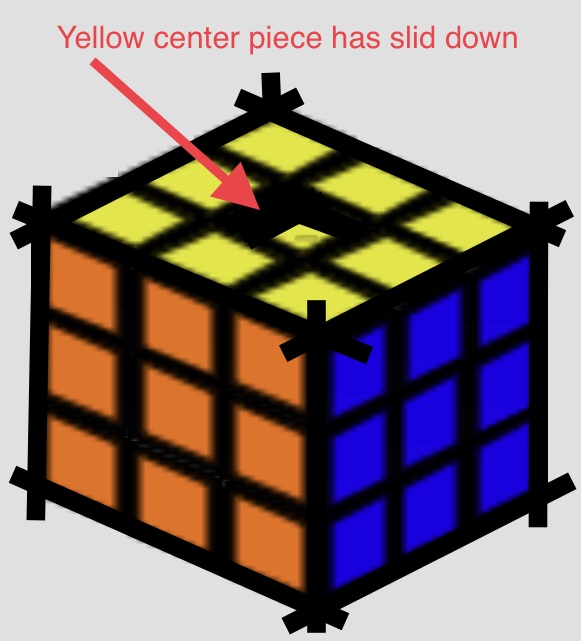
The Kube is surrounded by a thin, lattice-like metal frame, and inside it are 3x3x3-1 small transparent cubic pieces (26 pcs. in total). This means the center is currently hollow. The each piece is colored only on the outer side, with small metal pieces attached to each corner. Its inside is visible from outside, allowing us to determine the current location of the hollow space (cavity).
Observing the automated operation in demonstration mode, the gameplay is quite simple. One piece slides toward a cavity within a metal framework, and one of the other piece adjacent to the newly created cavity slides toward the cavity, and so on. This sliding process is repeated until 6 faces are completed(solved). Apparently, the winner of the competition is the person who solves the puzzle in the fewest moves, like FMC.
(Image)
(Source: https://ruwix.com/online-rubiks-cube-solver-program/)
That's the Klingon's Kube.
We're busy with missions and don't have time to tinker with the puzzle. So, we're sending it to you first, so please enjoy.
From Spock."
I took the actual item out of the package. Indeed, there are 26 small transparent cubic pieces inside that slide within an iron grate. I pushed one piece with my finger, and it slid easily. They slightly stuck to the outer frame, suggesting the metal frame has some magnetic force.
I'll play it for a while.
Thank you, Mr. Spock.
This Klingon's Kube is similar to The Rubik's Slide, but is different. The Rubik's Slide has 6 fixed center pieces, so these pieces doesn't slide, and also no piece can pass through the center of the cube.
"I'm sorry I wasn't able to give you the Möbius puzzle the other day. In exchange, please accept the enclosed item. I'll explain the situation now.
I told you that the puzzle you sent me was stolen by the Klingons, and shortly thereafter, the USS Enterprise received a transportation beam. Ms. Uhura reported to Captain Kirk that the beam was calculated to have been emitted from the distant planet Qo'noS (Kronos), the Klingons' homeworld.
Captain Kirk asked me if it was possible for a beam to reach us from such a distant location. I replied, "It depends on the weight of the object being transported. As you know, the amount of energy (E) is calculated as E = mc^2, and the lighter the mass (m), the less energy is required. They're probably sending something less than 100g."
Ms. Uhura then said, "Captain, we've received a transmission from the same planet. I'll put it on speaker."
"Hey Kirk. I was distracted by your Möbius puzzle the other day and almost got beaten. That puzzle is pretty well made, by the way. It's becoming increasingly popular on our planet. So, as a token of my gratitude, I've transported you a popular puzzle from our planet called "Kube". Please accept this. You'll hear a ticking noise, but don't worry, it's not a bomb. It's in demonstration mode so you can see how it works."
We went to the transportation room and found a small box. When we opened it, we found something resembling a Rubik's Cube. Apparently, on Klingon planet, a cube is called a Kube.
The Kube is surrounded by a thin, lattice-like metal frame, and inside it are 3x3x3-1 small transparent cubic pieces (26 pcs. in total). This means the center is currently hollow. The each piece is colored only on the outer side, with small metal pieces attached to each corner. Its inside is visible from outside, allowing us to determine the current location of the hollow space (cavity).
Observing the automated operation in demonstration mode, the gameplay is quite simple. One piece slides toward a cavity within a metal framework, and one of the other piece adjacent to the newly created cavity slides toward the cavity, and so on. This sliding process is repeated until 6 faces are completed(solved). Apparently, the winner of the competition is the person who solves the puzzle in the fewest moves, like FMC.
(Image)
(Source: https://ruwix.com/online-rubiks-cube-solver-program/)
That's the Klingon's Kube.
We're busy with missions and don't have time to tinker with the puzzle. So, we're sending it to you first, so please enjoy.
From Spock."
I took the actual item out of the package. Indeed, there are 26 small transparent cubic pieces inside that slide within an iron grate. I pushed one piece with my finger, and it slid easily. They slightly stuck to the outer frame, suggesting the metal frame has some magnetic force.
I'll play it for a while.
Thank you, Mr. Spock.
This Klingon's Kube is similar to The Rubik's Slide, but is different. The Rubik's Slide has 6 fixed center pieces, so these pieces doesn't slide, and also no piece can pass through the center of the cube.
Last edited:


