L5EOP, last five edges orientation and placement of the last first layer edge, is an experimental method for the 3x3x3 cube that is an alternative to L5E. In L5E the last five edges are first oriented without minding the permutation for the last first layer edge (normally the FD edge), then all five are permuted together. That makes 5 algs for L5EO (orientation) and 16 for L5EP (permutation). This method requires 20 algorithms for orientation and FD placement and on top of that you also need the 4 EPLLs that are used to end the solve.
In the cases where the last FL edge is solved by chance before this step knowing ELL will help a good bit, aspecially for the 4-flip case that is 11 turns optimal besides one single alg of 9 STM, that is not so fast to execute.
Usage of the method
Roux Method; ...
Columns First Methods; ...
Petrus Method, you initially skip the "bad edges" step and just do the "finish F2L" part. Because edges are not oriented at this point the pairs will be diffrent, but still easy, (you can benefit from using the empty side). Then, if you do COLL you use L5EOP after the pairs but better is to use CLL (or even CMLLs like R' U2 R U2 R U2 R U2 R') and do the edges after, it saves turns on average, end in EPLL. For OLL; edges after the pairs, CO and last PLL.
Cases
Testing a new image style:

This is the goal position for the five edges involved, UR, UF, UL, UB and FD. The four in U we only orient but the last one (yellow/green) must also be placed. If these images are not perfectly clear to you, then just click one of the algs in the listing for the particular case and you will ha a virtual cube showing the case and another click on the play button and it will animate the turns for you.
If you got the last case, the one with all edges correctly oriented, and if the last D edge is still up you can easily put it by doing AUF and then M' U2 M. Another option is to solve all the rest in one look using the permutations of L5E.
1+1 edge unoriented
2+0 edges unoriented (Adjacent)
A20D
|
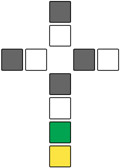
|
Use ELL to solve in one look.
|
|
|
2+0 edges unoriented (Opposite)
O20D
|
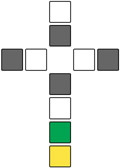
|
Use ELL to solve in one look.
|
|
|
3+1 edges unoriented
4+0 edges unoriented
40R/40L/40F/40B
|
40D
|
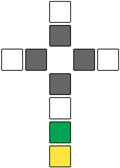
|
Use ELL to solve in one look.
|
|




