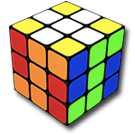
The EG method (Erik-Gunnar), so far only used for the 2x2x2 cube, only has two steps: solve one face, and then finish the entire cube in one algorithm. Without reflections, it requires 120 non-PBL algorithms. There are 3 bottom layer cases that each require the same amount of algorithms as CLL. Those that know CLL already know 1/3rd of EG, the EG 2 cases. The other two groups of cases have a Y permutation on bottom EG 0, and a T permutation on bottom EG 1. Some cubers have only learnt EG 2 and EG 1 case: you can cancel the last moves of making a face with 'R2 F2 R2' (0+0 PBL) if you see that you will have a EG 0 case, giving you a EG 2 algorithm (CLL). For this reason, there is no internet published list of the EG 0 cases, (or not a compleate one but the CxLL pages here in this wiki lists some of them and more are getting added so it will soon be compleate).
EG 2 (CLL) first layer
EG 1 first layer
EG 0 first layer
Another method that has been used for EG 0 is to inverse solve LL using normal CLL, say you got EG 0 and CxLL H D, then you can use the CLL for CxLL H U that will "solve" LL to diagonal permut and then add the permutation for PBL 0+0 in the end. In some cases, like this, the alg ends in R2 so the only extra turn you need to add is the F2, like this; orginal CLL R2 U2 R U2 R2 makes R2 U2 R U2 F2 R2 to solve the inverse CLL and 0+0 PBL. All CLL's has got a inverse CLL, to look at the pairs just set up one case and do the 0+0 PBL (R2 F2 R2) and you will have the inverse instead.
EG for 3x3?
It is possible to use EG for the 3x3x3 cube as a columns first method but with a diffrent set of algorithms. The idea is to orient four pairs without minding relative order and then sort the pairs and solve CLL using a EG algorithm, one that preserves the pairs, "Pairs EG" or PEG. But this has only been tested as a experimental method so far.