
For Christmas, I got some new cubes. I got a 4x4x4 an 4x2x2 cube. After mixing them all up, and learning a few new algorithms online and was doing good until I ran into parity issues. I found so many algorithms to fix party issues yet somewhere not working (not even close). I then released the issues I was running into was not that the algorithms where wrong, but how I was reading them was different, and confusing between sites. Then even on the same site explanations don't seem to match.
Example:
https://ruwix.com/twisty-puzzles/4x4x4-rubiks-cube-rubiks-revenge/
Under the section Notation, it clearly states and even shows in the picture that a lowercase letter is used to indicate a single layer next to the corresponding outside side.
Yet on the same website, it shows completely differently.
https://ruwix.com/the-rubiks-cube/notation/advanced/
On this page, it's clear that under the section "Two layers at the same time" that lowercase is more than one slice. It's both the inside and outside of a specific side.
This is confusing as all get out. Is this a typo on the Wiki website? Dw is only Japanese cubers?
Yet Dw is used by the official by the World Cube Association.
https://www.worldcubeassociation.org/regulations/#article-12-notation
To compound things even more according to the World Cube Association lowercase may be used to do cube rotation.
It seems an [f] is the same as a z, yet most websites will tell you to ignore () and [] they are just to assist with memorization.
Long story short when you see...
B2 U2 l U2 R' U2 r F2
What exactly are l and r. Do they flip the cube around? Do you move 2 layers at once or just the second layer?
I have noticed most people always suggest that one should verify by the website what the notation format is. The problem is websites conflict with themselves as I have explained above (first two examples are both on ruwix.com). And many places will not even explain what their notation is.
A few ways I have thought of it is as follows..
If a "w" exists in the formula then a lowercase letter would mean a single layer.
If square brakes exist around any lowercase letters (single move) then I would assume the lowercase letters indicate cube rotation. (don't think I have seen this yet)
But if I don't see either one of those in a formula then I can't easily tell if lowercase is to rotate entire side or single slice.
I am hoping to ask others such as yourselves how do you figure out what notation someone is using. Any suggestions as to what is more commonly used (even if it's not official etc.)
Example:
https://ruwix.com/twisty-puzzles/4x4x4-rubiks-cube-rubiks-revenge/
Under the section Notation, it clearly states and even shows in the picture that a lowercase letter is used to indicate a single layer next to the corresponding outside side.
f – Lowercase letters mark inner slice turns. u' = Uw' U
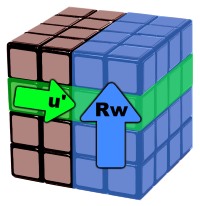
Yet on the same website, it shows completely differently.
https://ruwix.com/the-rubiks-cube/notation/advanced/
On this page, it's clear that under the section "Two layers at the same time" that lowercase is more than one slice. It's both the inside and outside of a specific side.
For example d means the clockwise rotation of the two bottom layers. Dw means the same move but this notation is mainly used by Japanese cubers.
[IMG='width:170px;']https://ruwix.com/pics/notation/rubiks-cube-notation-small-d.png[/IMG]
This is confusing as all get out. Is this a typo on the Wiki website? Dw is only Japanese cubers?
Yet Dw is used by the official by the World Cube Association.
https://www.worldcubeassociation.org/regulations/#article-12-notation
To compound things even more according to the World Cube Association lowercase may be used to do cube rotation.
Code:
    12b) Rotations for all NxNxN puzzles:
        12b1) Clockwise, 90 degrees: [f] or z, [b] or z', [r] or x, [l] or x', [u] or y, [d] or y'.
        12b2) Counter-clockwise, 90 degrees: [f'] or z', [b'] or z, [r'] or x', [l'] or x, [u'] or y', [d'] or y.
        12b3) 180 degrees: [f2] or z2, [b2] or z2, [r2] or x2, [l2] or x2, [u2] or y2, [d2] or y2.
It seems an [f] is the same as a z, yet most websites will tell you to ignore () and [] they are just to assist with memorization.
Long story short when you see...
B2 U2 l U2 R' U2 r F2
What exactly are l and r. Do they flip the cube around? Do you move 2 layers at once or just the second layer?
I have noticed most people always suggest that one should verify by the website what the notation format is. The problem is websites conflict with themselves as I have explained above (first two examples are both on ruwix.com). And many places will not even explain what their notation is.
A few ways I have thought of it is as follows..
If a "w" exists in the formula then a lowercase letter would mean a single layer.
If square brakes exist around any lowercase letters (single move) then I would assume the lowercase letters indicate cube rotation. (don't think I have seen this yet)
But if I don't see either one of those in a formula then I can't easily tell if lowercase is to rotate entire side or single slice.
I am hoping to ask others such as yourselves how do you figure out what notation someone is using. Any suggestions as to what is more commonly used (even if it's not official etc.)
Last edited:


