

One day, Master Yoda came to visit me after a long time. I said, "Master Yoda, it's been a while. By the way, how was that puzzle? You haven't come for a while, so I was wondering if it was taking you a long time to solve."
He replied, "No way, that puzzle on my way home I solved. The flipping edges were frustrating at first I admit, but because I'd trained myself with Othello, where the black and white flip, the logic I quickly understood and adapted. Then, the other day, the 1000x1000 puzzle I finally solved, and so, I've put 180 star marks on it, and currently playing with it I am."
Master Yoda is truly impressive. His spirit of challenge is incredible!
He continued, "By the way, the other day, while my usual finger exercises with the 2x2 cube I was doing, a question suddenly came to mind..."
He explained as follows:
Each piece on the cube is colored, so there is a correlation between the movement of a piece and the movement of its color. In a normal cube, the amount of the former and the amount of the latter are equal. For example, if a piece is rotated 90 degrees, its color also rotates 90 degrees. Since the color placement after rotation is predictable, there is a method of solution.
But what if there is no correlation between them? For example, if the color of a piece changes randomly when you rotate R or U, there is no solution because the color placement after rotation is unpredictable.
Then, what if there is a correlation between the movement of a piece and the movement of its color, but the amount of movement is different? For example, if there is a cube in which the color of its side rotates 180 degrees when a slice is rotated 90 degrees, is there a solution?
With a real 2x2 cube, such movement would only be possible with an electric device or virtually, but it can be simulated with a 4x4 cube.
The steps are as follows:
(See the picture below)
1. Align the colored areas (centers) as the picture below. Ignore the uncolored areas.
2. Scramble the cube, rotating the inner slice (r, l, f, b, u, d) by 1QTM and the adjacent outer face (R, L, F, B, U, D) by 2QTM simultaneously, repeatedly (more than 10 times).
3.Start and complete solving, rotating the inner slice by 1QTM and the adjacent outer face by 2QTM simultaneously, just done as with scramble. Do not rotate only the inner slice or only the outer face.
(Image: 4x4 cube simulating 2x2)
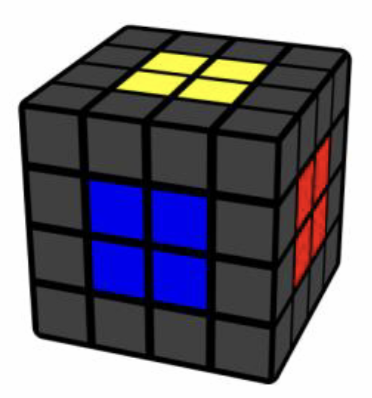
(Source: https://www.cubeskills.com/uploads/pdf/tutorials/beginners-method-for-solving-the-4x4-cube.pdf)
Since we're not used to situations where the amount of movement between pieces and colors differs, even a simple 2x2 cube can be quite difficult to solve.
Master Yoda conjectures that a method of solution is possible because there is a correlation between the movement of pieces and the movement of colors, but is this really the case?
He replied, "No way, that puzzle on my way home I solved. The flipping edges were frustrating at first I admit, but because I'd trained myself with Othello, where the black and white flip, the logic I quickly understood and adapted. Then, the other day, the 1000x1000 puzzle I finally solved, and so, I've put 180 star marks on it, and currently playing with it I am."
Master Yoda is truly impressive. His spirit of challenge is incredible!
He continued, "By the way, the other day, while my usual finger exercises with the 2x2 cube I was doing, a question suddenly came to mind..."
He explained as follows:
Each piece on the cube is colored, so there is a correlation between the movement of a piece and the movement of its color. In a normal cube, the amount of the former and the amount of the latter are equal. For example, if a piece is rotated 90 degrees, its color also rotates 90 degrees. Since the color placement after rotation is predictable, there is a method of solution.
But what if there is no correlation between them? For example, if the color of a piece changes randomly when you rotate R or U, there is no solution because the color placement after rotation is unpredictable.
Then, what if there is a correlation between the movement of a piece and the movement of its color, but the amount of movement is different? For example, if there is a cube in which the color of its side rotates 180 degrees when a slice is rotated 90 degrees, is there a solution?
With a real 2x2 cube, such movement would only be possible with an electric device or virtually, but it can be simulated with a 4x4 cube.
The steps are as follows:
(See the picture below)
1. Align the colored areas (centers) as the picture below. Ignore the uncolored areas.
2. Scramble the cube, rotating the inner slice (r, l, f, b, u, d) by 1QTM and the adjacent outer face (R, L, F, B, U, D) by 2QTM simultaneously, repeatedly (more than 10 times).
3.Start and complete solving, rotating the inner slice by 1QTM and the adjacent outer face by 2QTM simultaneously, just done as with scramble. Do not rotate only the inner slice or only the outer face.
(Image: 4x4 cube simulating 2x2)
(Source: https://www.cubeskills.com/uploads/pdf/tutorials/beginners-method-for-solving-the-4x4-cube.pdf)
Since we're not used to situations where the amount of movement between pieces and colors differs, even a simple 2x2 cube can be quite difficult to solve.
Master Yoda conjectures that a method of solution is possible because there is a correlation between the movement of pieces and the movement of colors, but is this really the case?
Last edited:


