Maritan method
| ||||||||||||||||||||||

This method uses algorithms that allow you to proceed with a layer by layer or corner first approach independently.
It does not aim to be a fast method of resolution, but since it is intuitive and equipped with few algorithms to memorize, it is more suitable for beginners who want to understand the dynamics of rotation and operation of the few algorithms used.
Steps
- First Step - Position and orient the corners of the first layer.
- Second step - Arrange and orient edges of first and second layer.
- Third step - Position and orient the corners of the last layer.
- Fourth Step - Finish the cube with last four edges of the last layer.
First Step
 No special algorithms are provided. The corners will be inserted intuitively.
Second Step
 It starts from the edges of the first layer. Hold the first layer (white face) either in R or in L
- Algorithm used for turning edges counterclockwise (From now, we will call it B1):
R’ D R E (or E’ or E2)* R’ D’ R E’ (or E or E2)**

- Algorithm used for turning edges clockwise (From now, we will call it B2):
L D’ L’ E’ (or E or E2)* L D L’ E (or E’ or E2)**

Notes: * We move the middle layer to the right or left according to the nearest wrong edge. ** Obviously the move will be opposite to the one chosen in the previous point.
It is not excluded that it may be necessary to apply conjugates to have the edge to be inserted in one of the indicated positions.
 For the positioning of the edges of the second layer we will hold the first layer (white face) in U and we will always use the same algorithms (named B1 and B2) used in the second step.
Also in this case it may be useful to use the technique of conjugates in combination with the algorithms.
The last edge of the second layer, having finished the wrong edges useful for the execution of the two algorithms, it will be move (by turning the face to which it belongs) bringing it to the third layer. Execute one of the two algorithms B1 or B2, so arrange the edge and carry it back into the second layer by reverse rotation of the previously rotated face (conjugates).
Third Step
 Now we want to place the corners in the correct position as shown in the image. From now the last layer (yellow face) must be in F position.
- Algorithm used for permuting two corners in L position (From now, we will call it A1):
Dw’ L D F L F’ L’ E
- Algorithm used for permuting two corners in R position (From now, we will call it A2):
Dw R’ D’ F' R’ F R E’
Then orienting the corner  applying the algorithm twice, as shown in the table below:
- Position n.1
 Solve state

- Position n.2
 A1 x 2 times -> POS. 1

- Position n.3
 A1 x 2 times -> POS. 2

Alternatively, this can be done: x' A2 x 2 times -> POS. 1
- Position n.4
 A1 x 2 times -> POS. 2

- Position n.5
 A1 x 2 times -> POS. 2

- Position n.6
 A1 x 2 times -> POS. 3

- Position n.7
 A1 x 2 times -> POS. 3

- Position n.8
 A1 x 2 times -> POS. 3

Fourth Step
The cube is concluded by permuting and orienting the edges of the last layer. Immediately we solve the first edge with one of the two algorithms B1 or B2. Now for the 3 remaining edges, the situation will be the following:

There is 12 cases of this situation all resolvable through the execution of the algorithms B1, B2 or both:
- Position n.1
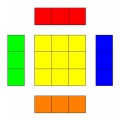 Solve state

- Position n.2
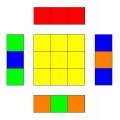 B1 D y B2 D’

- Position n.3
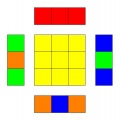 B2 D’ y’ B1 D

- Position n.4
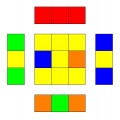 D’ y’ B1 D

- Position n.5
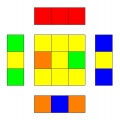 D y B2 D’

- Position n.6
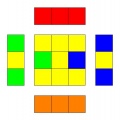 B1 D y B2 D’ y’ B1

- Position n.7
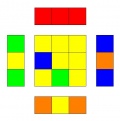 B2

- Position n.8
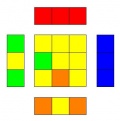 B1 B2

- Position n.9
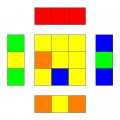 D’ y’ B1 D y B2

- Position n.10
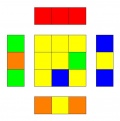 B1

- Position n.11
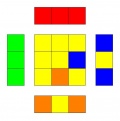 B2 B1

- Position n.12
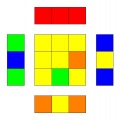 D y B2 D’ y’ B1

Once the dynamics of the two algorithms B1 and B2 are understood, it will not be necessary to memorize any of the possible positions.
Extras for 4x4x4
- Algorithm B1.1
R’ D R u (or u’ or u2) R’ D’ R u’ (or u or u2)
- Algorithm B1.2
R’ D R d (or d’ or d2) R’ D’ R d’ (or d or d2)
B1 always acts on the right side, but in particular: B1.1 on the layer above and B1.2 on the layer below.
- Algorithm B2.1
L D’ L’ u’ (or u or u2) L D L’ u (or u’ or u2)
- Algorithm B2.2
L D’ L’ d’ (or d or d2) L D L’ d (or d’ or d2)
B2 always acts on the left side, but in particular: B2.1 on the layer above and B1.2 on the layer below.


