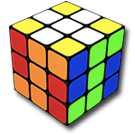
Nautilus
| ||||||||||||||||

Nautilus is a speedsolving method developed by Michael James Straughan. It was originally developed in 2006 but was re-developed with additional variants starting in 2020. The method has since become an overall concept of reaching the <U, r U r'> move group, where puzzles even outside of 3x3 have a state where the last layer is unsolved and all of the front layer pieces are unsolved except for the very left side.
Steps
The idea is to build upon the Roux method by getting the DB edge solved early, leading to the rest of the solve being completely automatic and the final edge step being one-lookable without thousands of cases.
- Shell: Build a 1x2x3 at dL then build a 2x2x2 at dbr.
- Last Pair: Add the last pair at dFR.
- Corners: Solve the corners of the upper layer.
- L5E: Solve the last five edges. There are 245 cases.
Advantages to having DB solved
- Easier to recognize L5E while solving the corners versus full LSE.
- Advancements can more easily be implemented. A major complaint against the Roux method is that there are no big advancements like ZB for CFOP. With the DB edge solved, the number of edge cases is reduced and it becomes easier to combine the final steps. One thing Roux users have tried is CMLLEO, influencing EO while solving CMLL. But there are too many edge cases and poor visibility, making this complex. With Nautilus it is much easier to build an algorithm set that solves the corners and orients edges.
- The last pair is more easily tracked, recognized, and solved automatically or by using algorithms.
- Less effort to learn the 245 L5E algorithms to reach near optimal move count of 11 moves versus the 1,000 to 2,000 one look LSE cases at 11 moves or EOLRb at 13 to 13.5 moves.
- Additional move sets can more easily be implemented in the last edges step. Because L5E is algorithm based, the solver can use memorized and practiced algorithms that have the best ergonomics that don't always stick to <M, U>.
- There is no dots case or ambiguous or difficult M slice 3 cycle recognition.

Pros and Cons
Pros
- Great look-ahead for the rest of the solve after the primary shape is built.
- Most of the solve involves the use of only the dominant hand.
- Good for both two handed and one handed solving.
- Rotationless.
- Low move-count.
Cons
- Requires learning more algorithms compared to CFOP, Petrus, and ZZ without ZBLL, and base Roux.
- The 2x2x2 block building requires strategies not used in other methods.
Variants
LSLL
- After the primary method shape, orient all edges while inserting the DF edge.
- Finish using any LSLL method.

LL
- Completely solve the empty square. This can be performed intuitively or with algorithms. If all edges are oriented, there are 116 algorithms that average 8 moves. When edges aren't oriented, there are 467 algorithms.
- Solve the last layer using any variant.

Adaptions to Other Puzzles
The Nautilus concept of <U, r U r'> solving is easily adaptable to many puzzles. Below are some of the puzzles for which Nautilus has been developed.
FTO

Square-1
Ryan Hudgens (OreKehStrah) adapted Nautilus to Square-1. Ryan Hudgens' Nautilus Square-1 guide

Big Cubes
Webpage for using Nautilus on big cubes

History
In 2006, the MI1 method was developed. The primary shape in that method was very close to the one in Nautilus. The only difference being that the DR edge wasn't solved. It was found that having the DR edge slot be empty caused problems for ergonomics. So that same year it was decided to solve the DR edge along with the rest of the shape and branch Nautilus off into its own method. This produced much better ergonomics and led to better variants. In 2020 new, more advanced variants were added to the method.