The other day, Doc replied to my solving method to the Accelerating Reels puzzle, saying, "Well done!"
He then told me that he had come up with another puzzle after seeing some kids in the past world playing with a string threaded through a line of pulleys, spinning them around.
He also sent me a diagram outlining the puzzle, which looks like this:
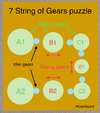
Puzzle Overview:
1. A total of 7 main gears are fixed to the wood board. The gear number, number of teeth, and numbers written clockwise on the top (circumference) of each gear are as follows:
Gear Teeth Numbering
A1 100 0 to 9 (10 numbers)
B1 90 0 to 8 (9 numbers)
C1 80 0 to 7 (8 numbers)
D1 70 0 to 6 (7 numbers)
C2 80 0 to 7 (8 numbers)
B2 90 0 to 8 (9 numbers)
A2 100 0 to 9 (10 numbers)
2. A total of 6 idler gears (16 teeth) are placed between the main gears, and are fixed by meshing with A1, C1, A2, and C2.
3. B1 and B2 are sliding gears that slide left and right, and D1 slides up and down, meshing with the idler gears.
4. The way to play is as follows:
1) Rotate the main gears randomly and stop them where one of the numbers is at the top. This is a scramble, and the play starts here.
2) Slide one of the sliding gears (B1, B2, D1) and rotate it while meshing with the adjacent idler gear. Rotating 2 main gears at the same time (it is illegal to rotate a main gear alone or three main gears at the same time).
3) Return the slid sliding gear to its original position.
4) Repeat steps 2) and 3) above until the numbers at the top of all main gears become same (from 0 and 6), and the problem is solved.
5) The winner is the person who completes solve without rotating the gears as much as possible. The number of moves is calculated by how many times the number on the top row changes.
Let's try solving this using an example.
The numbers on the top row of each main gear are as follows. (From now on, I will omit the term "top row.")
A1B1C1D1C2B2A2
1 2 3 4 2 2 2 → scrambled
In this case, I rotated the gears as follows:
A1B1C1D1C2B2A2
1 2 3 4 2 2 2
↓ Connect B1 to A1 and turn B1 slightly to change 2 to 3. At this time, A1 is 2.
2 3 3 4 2 2 2
↓ Connect B1 to C1 and turn B1 slightly to change 3 to 2. At this time, C1 becomes 2.
2 2 2 4 2 2 2
↓ Connect D1 to C1, rotate D1 clockwise two times, then rotate it a little more to set it to 2. At this time, C1 will remain at 2.
2 2 2 2 2 2 2 → solved
Total: 18 moves
Alternatively, I could solve it by doing it like this:
A1B1C1D1C2B2A2
1 2 3 4 2 2 2
↓ Connect D1 to C1, rotate D1 clockwise twice, then rotate it a little more to make it 2. At this time, C1 will remain at 3.
1 2 3 2 2 2 2
↓ Connect B1 to C1 and turn B1 slightly to change 2 to 1. At this time, C1 becomes 2.
1 1 2 2 2 2 2
↓ Connect B1 to A1 and turn B1 slightly to change 1 to 2. At this time, A1 becomes 2.
2 2 2 2 2 2 2 → solved
Total: 18 moves
In this example, the number of the three bottom row main gears is 2, so it's relatively easy to know that you just need to rotate the other gears to make them all equal.
But wait a minute!
After thinking about it again, I realized I could solve it in much fewer moves!
So, readers, can you guess how I solved it?
He then told me that he had come up with another puzzle after seeing some kids in the past world playing with a string threaded through a line of pulleys, spinning them around.
He also sent me a diagram outlining the puzzle, which looks like this:
Puzzle Overview:
1. A total of 7 main gears are fixed to the wood board. The gear number, number of teeth, and numbers written clockwise on the top (circumference) of each gear are as follows:
Gear Teeth Numbering
A1 100 0 to 9 (10 numbers)
B1 90 0 to 8 (9 numbers)
C1 80 0 to 7 (8 numbers)
D1 70 0 to 6 (7 numbers)
C2 80 0 to 7 (8 numbers)
B2 90 0 to 8 (9 numbers)
A2 100 0 to 9 (10 numbers)
2. A total of 6 idler gears (16 teeth) are placed between the main gears, and are fixed by meshing with A1, C1, A2, and C2.
3. B1 and B2 are sliding gears that slide left and right, and D1 slides up and down, meshing with the idler gears.
4. The way to play is as follows:
1) Rotate the main gears randomly and stop them where one of the numbers is at the top. This is a scramble, and the play starts here.
2) Slide one of the sliding gears (B1, B2, D1) and rotate it while meshing with the adjacent idler gear. Rotating 2 main gears at the same time (it is illegal to rotate a main gear alone or three main gears at the same time).
3) Return the slid sliding gear to its original position.
4) Repeat steps 2) and 3) above until the numbers at the top of all main gears become same (from 0 and 6), and the problem is solved.
5) The winner is the person who completes solve without rotating the gears as much as possible. The number of moves is calculated by how many times the number on the top row changes.
Let's try solving this using an example.
The numbers on the top row of each main gear are as follows. (From now on, I will omit the term "top row.")
A1B1C1D1C2B2A2
1 2 3 4 2 2 2 → scrambled
In this case, I rotated the gears as follows:
A1B1C1D1C2B2A2
1 2 3 4 2 2 2
↓ Connect B1 to A1 and turn B1 slightly to change 2 to 3. At this time, A1 is 2.
2 3 3 4 2 2 2
↓ Connect B1 to C1 and turn B1 slightly to change 3 to 2. At this time, C1 becomes 2.
2 2 2 4 2 2 2
↓ Connect D1 to C1, rotate D1 clockwise two times, then rotate it a little more to set it to 2. At this time, C1 will remain at 2.
2 2 2 2 2 2 2 → solved
Total: 18 moves
Alternatively, I could solve it by doing it like this:
A1B1C1D1C2B2A2
1 2 3 4 2 2 2
↓ Connect D1 to C1, rotate D1 clockwise twice, then rotate it a little more to make it 2. At this time, C1 will remain at 3.
1 2 3 2 2 2 2
↓ Connect B1 to C1 and turn B1 slightly to change 2 to 1. At this time, C1 becomes 2.
1 1 2 2 2 2 2
↓ Connect B1 to A1 and turn B1 slightly to change 1 to 2. At this time, A1 becomes 2.
2 2 2 2 2 2 2 → solved
Total: 18 moves
In this example, the number of the three bottom row main gears is 2, so it's relatively easy to know that you just need to rotate the other gears to make them all equal.
But wait a minute!
After thinking about it again, I realized I could solve it in much fewer moves!
So, readers, can you guess how I solved it?
Last edited: